


It’s 3 PM in July. The outdoor temperature is hovering near 45 °C, your air conditioning unit is on maximum, you can hear the compressor working and the fans turning, the vents are open, and your living room still feels like being inside an overheated car. If you have been living in Dubai for at least one summer season, there is no doubt you know the situation pretty well. This is probably the most frequent problem reported to our team during the hot months from May until September, and the problem can be caused by one of the very few factors in nine cases out of ten. After many years of dealing with the same problems in Dubai apartments, villas, and offices, we understand that the “AC not cooling” issue doesn’t necessarily require an urgent visit by our specialists; it just needs five minutes to perform the necessary checks.
Here we will give you step-by-step instructions on how to check whether your AC is functioning properly and the top 10 reasons why it stops cooling in Dubai.
Why Dubai ACs Are Especially Prone to Cooling Problems
However, jumping into the list of causes, one needs to understand what makes it occur so often in this region, in particular. There are three reasons why air conditioners in the UAE have to operate in much harsher conditions compared to units located in a milder climate zone:
- Extreme heat load: When the outdoor temperature exceeds 45 °C, the condenser of your unit has to reject a tremendous quantity of heat in order to keep the indoor coil operable. Even minor inefficiency- a dirty or less-than-sufficient coil – will become visible immediately.
- Heavy dust and sand: The fine desert dust gets inside your unit everywhere: filters, coils, ducts, and outdoor condenser fins. While in another region a filter could be plugged in about six months, in this region it will happen three or four weeks earlier.
- High humidity, especially near the coast: Due to the high humidity level, the air conditioning systems work by extracting considerable amounts of water from the atmosphere, thus straining the drainage and providing the perfect conditions for the development of sludge, mold, and drain line blockages.
Remember these three factors in mind as you read through the list below; almost every cause traces back to one of them.
10 Common Causes of an AC Not Cooling in Dubai
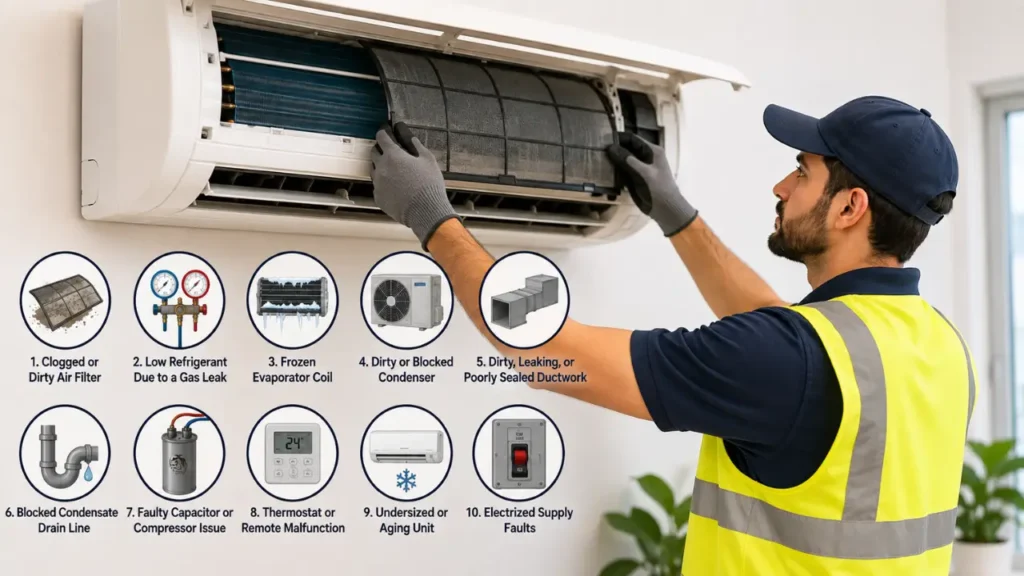
1. A Clogged or Dirty Air Filter
There is no doubt about it; this is easily the commonest cause of an inefficient or overheated AC in the UAE. The function of the air filter is to screen out dirt before it gets to the indoor coil, and the air in Dubai is far dustier compared to other cities. When the filter is blocked, the efficiency of the airflow through the coil reduces significantly, making it difficult for the unit to extract heat from the indoors.
DIY fix: Rinse the filter using water and then put it back in place. This should be done after every 2-4 weeks in the peak summer months.
2. Low Refrigerant Due to a Gas Leak
If the air blown into the room is only slightly cool, you hear some hissing noise around either the indoor or outdoor unit, or there is a presence of frost on the copper refrigerant lines, insufficient refrigerant could be the cause. At this stage, it is important to understand that refrigerant is a sealed system fluid; it is not used up in any way in the normal functioning process of the AC unit.
Why a quick top-up isn’t a real fix: The most common inexpensive service performed in such cases includes simply adding some gas and sending the technician away. Not repairing the leakage will eventually lead to the AC blowing out warm air after a month or so, requiring the replenishing again.
Fix: This is strictly a job for a licensed technician with leak-detection tools, a vacuum pump, and the right refrigerant type for your unit.
3. A Frozen Evaporator Coil
Opening the indoor unit to find an accumulation of ice in the coil or the copper lines means that the evaporator is frozen. When this occurs, the effectiveness of cooling is drastically reduced since ice is not a good conductor of heat. Freezing is typically a sign of another problem. It may be blocked airflow due to a clogged filter, or a low refrigerant level resulting in the coil getting below the freezing temperature.
DIY fix: Completely turn off the AC and place it in fan mode (or switch it off). The melting process will take several hours without intervention. Do not attempt to manually remove ice from the coil; you could damage the copper tubing. When the coil is melted, check the filter and determine if the problem still persists.
4. A Dirty or Blocked Condenser (Outdoor Unit)
The role of the outdoor condenser unit is to dispose of the heat collected by the air conditioning system from inside the home. In Dubai, the aluminum fins of the condenser get clogged very fast by dust, sand, and other particles present in the air, especially in systems that are installed near building sites or at the ground floor level. If the condenser unit is blocked, then it would not be able to disperse heat well, and the entire system will have to work more while producing less efficiency.
DIY fix: Rinsing the accessible fins using a garden hose (do not use high-pressure water jets since the fins could bend) is helpful. A full chemical coil clean, however, is best left to a technician as part of a proper AC service.
5. Dirty, Leaking, or Poorly Sealed Ductwork
Dust accumulation or leakage at the joints will cause a situation where certain rooms are cool while other rooms are still hot when you are using a central or ducted AC. Air leakage from the joints makes the cooled air seep into the ceiling void before it ever reaches your living space. While dust-clogged ducts restrict airflow the same way a dirty filter does, except spread across your entire home.
Fix: Duct inspection, sealing, and professional cleaning. You should not attempt this yourself, because ducts are located above false ceilings and can only be inspected and cleaned with special equipment.
6. A Blocked Condensate Drain Line
While your AC system will cool the air, it will pull a substantial amount of moisture from the air. In a city like Dubai where the atmosphere is humid, the system collects several liters of moisture daily. The collected moisture should be drained via the drain pan and drain line. Gradually, dust gets into the collected moisture and turns into sludge, leading to blockage of the drain line. Some modern systems come with a safety float switch that will shut off the system when the drain pan is filled with water. This is why a blocked drain line may be seen as “the AC stopped cooling” rather than visible water damage.
Symptoms: Dripping water from the indoor unit, wet patches on the ceiling, musty odor or lack of cooling for no obvious reason.
Fix: A drain line flush is quick and inexpensive for a technician, and far cheaper than repairing a water-damaged ceiling. That would be needed in case of an ignored drain problem.
7. A Faulty Capacitor or Compressor Issue
If your outdoor unit produces humming sounds, but the fan blade does not move, or your compressor fails to work and keeps clicking, then a faulty capacitor might be the reason for that. The capacitor provides a starting impulse of power to the compressor and fan motor. When the capacitor deteriorates, the motor has problems starting, and the result is a burden to the compressor, which is the most expensive part of your air conditioner.
Important safety note: The capacitor accumulates electrical charge even if the air conditioner is turned off and can give you a very painful shock. This is something only a professional technician can fix.
8. Thermostat or Remote Control Malfunction
In some instances, the AC system itself could be fine, but the control device giving it its operating instructions could have the problem. This is when there will be no room temperature conformity between actual temperature and the set temperature, when the AC turns on and off repeatedly in short bursts, or the display shows erratic behavior.
DIY fix: First, replace the batteries in a wireless control or thermostat and make sure that the device is not installed in a peculiar place such as a window or sun-exposed area or right beside a supply vent, since this gives the device an incorrect temperature reading.
9. An Undersized or Aging Unit
If you find that your AC has never coped well during peak summer, works non-stop, and has a hard time in the largest or sunniest room. Then the cause of the problem may not be a fault, but just a lack of power for such a room. Air conditioning’s cooling power should correspond to the room size, ceiling height, window area, and sun exposure. Changes made to the room, like adding glass walls, opening partitions, or enlarging the room, can silently exceed the capacity of the installed unit. Also, units that are more than 10–12 years old have already lost some of their initial cooling capacity.
Fix: An accurate calculation done by a specialist will help you to understand what is necessary to fix, either duct change, new installation, or better insulation/shading.
10. Electrical Supply Faults
If your air conditioner continues to trip the breaker, causes your lights to flicker when the compressor turns on, or gives off a burning smell around the distribution panel, then it’s an electrical problem, not a mechanical one. The breaker is simply doing what it’s supposed to by stopping any fault in the home’s electrical system, be it faulty wiring, malfunctioning components sucking too much power, or a faulty connection.
Fix: Stop using the unit and call an AC technician immediately. Repeatedly resetting a breaker that keeps tripping is a fire risk, not a solution.
5 Quick DIY Checks Before You Call Anyone
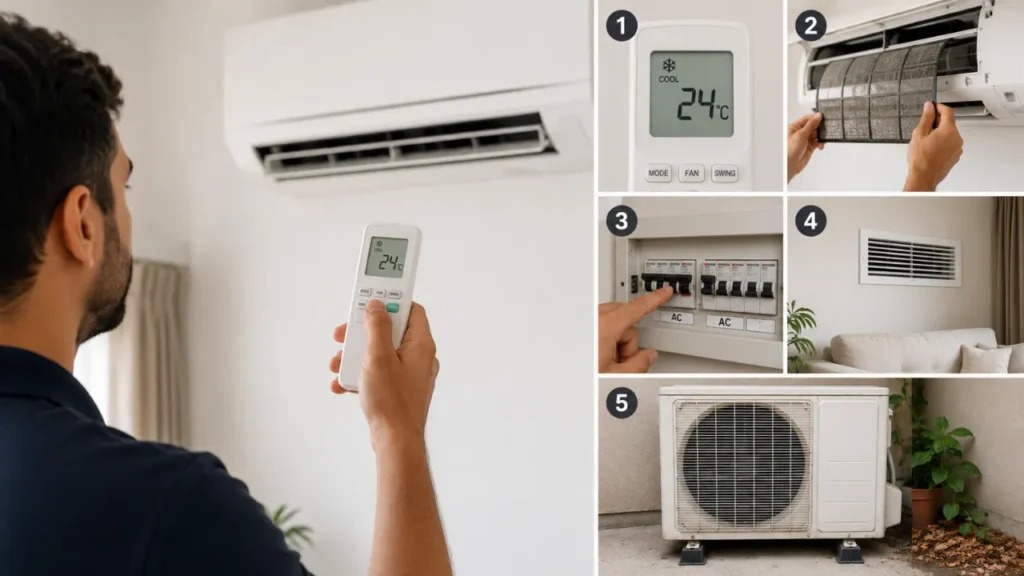
Before assuming the worst, run through this two-minute checklist. It resolves a surprising number of “my AC isn’t cooling” calls without any tools or technical knowledge.
- Check the mode and temperature setting. It sounds obvious, but it’s the single most common false alarm. Confirm the remote or thermostat is set to Cool mode, not Fan, Dry, or Auto, and that the target temperature is a few degrees below the current room temperature. A stray tap on the remote, or a child playing with it, is often the entire “problem.”
- Pull out and inspect the air filter. Slide open the front panel of your indoor unit and remove the filter. If it’s grey, matted, or you can’t see light through it, that’s your answer. Rinse it under running water, let it air-dry completely, and put it back.
- Look at the breaker panel. Open your distribution board (DB) and check whether the AC’s breaker has tripped. You can reset it once. If it trips again immediately, stop; that’s a sign of a real electrical fault, not something to keep resetting.
- Check vents, returns, and furniture placement. Walk through the room and confirm that supply vents are fully open and that nothing- curtains, sofas, wardrobes, stacked boxes- is blocking the return air grille. Restricted airflow on either side chokes the whole system.
- Inspect the outdoor condenser unit. If you have access to your outdoor unit (on a balcony, rooftop, or ground-level pad), check that it’s running, that its fan is spinning, and that it isn’t buried in dust, sand, leaves, or stored items. The condenser needs open space around it to dump heat outside; a smothered unit simply can’t cool efficiently.
If one of these five checks solves the problem, you’ve saved yourself a callout fee. If cold air still isn’t coming through, one of the ten causes below is almost certainly responsible.
Typical AC Repair Costs in Dubai (2026 Estimates)
Costs vary by unit size, brand, and building type, but these are typical market ranges across Dubai to help you budget before booking a visit.
| Service | Typical Cost (AED) |
| Diagnostic/call-out visit | 100 – 200 |
| Filter cleaning & basic service | 120 – 250 |
| Refrigerant leak detection, repair & regas | 350 – 800 |
| Frozen coil diagnosis & repair | 200 – 500 |
| Condenser coil cleaning | 150 – 350 |
| Duct cleaning (per system) | 400 – 900 |
| Drain line flush | 100 – 200 |
| Capacitor replacement | 150 – 300 |
| Thermostat replacement | 200 – 400 |
| Compressor replacement | 1,200 – 3,000+ |
Note: Prices are indicative and can vary depending on unit tonnage, brand, accessibility, and building type. Always ask for a fixed quote after diagnosis, before repair work begins.
How to Prevent This From Happening Again
Nearly every cause on this list is preventable with routine maintenance, done ahead of summer rather than in the middle of it:
- Clean filters every 2–4 weeks during peak cooling months.
- Schedule a professional AC service twice a year, ideally once before summer (March–April) and once in autumn, including coil cleaning, drain flushing, and a refrigerant pressure check.
- Keep the outdoor condenser clear of dust, storage items, and anything within 30–50cm of its airflow path.
- Set a sensible, steady temperature (around 23–24°C) rather than constantly adjusting it, this reduces strain on the compressor and capacitor.
- Consider an annual maintenance contract (AMC) if you’d rather not track service dates yourself; a good AMC includes scheduled visits and priority response if something fails during peak summer.
When You Should Stop Troubleshooting and Call a Technician
DIY checks are genuinely useful for the first few causes on this list, the filter, the settings, a tripped breaker, blocked vents. But you should stop and call a professional immediately if you notice any of the following:
- A hissing sound or visible frost on refrigerant lines
- A breaker that trips again immediately after resetting
- A burning smell anywhere near the unit or the DB panel
- Water actively dripping or pooling near the indoor unit
- The outdoor fan or compressor not starting despite power reaching the unit
Attempting to fix any of these yourself isn’t just unlikely to work; it can be genuinely dangerous, given the electrical currents and pressurized refrigerant involved.
Same-Day AC Repair in Dubai
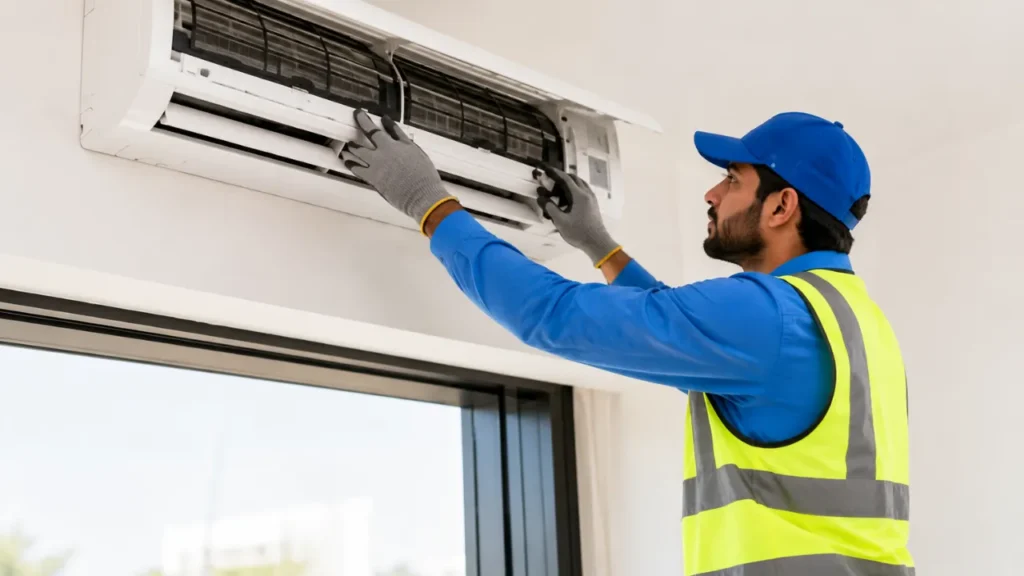
If you’ve worked through the checklist above and your AC still isn’t cooling, the smartest next step is a proper diagnosis rather than more guesswork. Our team at MD Technical Services LLC handles emergency AC repair across Dubai, split units, ducted systems, and FCUs, with technicians who can usually reach you the same day, a clear price confirmed before any work starts, and no guesswork billing. Whether it’s a slow refrigerant leak, a failing capacitor, or a system that’s simply overdue for a proper service, we’ll find the actual cause and fix it once, not repeatedly.
Final Thoughts
An AC that won’t cool properly in Dubai’s heat is more than an inconvenience; left unresolved, small issues like a dirty filter or a minor refrigerant leak tend to escalate into bigger, more expensive repairs, from frozen coils to compressor damage. The good news is that the checks in this guide will resolve a large share of cases on their own, and for everything else, knowing exactly what’s likely wrong means you can describe the problem clearly, get a faster diagnosis, and avoid paying for guesswork.
If you’ve worked through the checklist above and your AC is still struggling to cool, it’s time to bring in a professional who can pinpoint the exact cause and fix it properly, the first time.