
Categories AC Tips

AC Not Cooling in Dubai? 10 Causes and DIY Checks Before Calling a Technician

AC Not Cooling in Dubai 10 Causes and DIY Checks Before Call a Technician

It’s 3 PM in July. The outdoor temperature is hovering near 45 °C, your air conditioning unit is on maximum, you can hear the compressor working and the fans turning, the vents are open, and your living room still feels like being inside an overheated car. If you have been living in Dubai for at least one summer season, there is no doubt you know the situation pretty well. This is probably the most frequent problem reported to our team during the hot months from May until September, and the problem can be caused by one of the very few factors in nine cases out of ten. After many years of dealing with the same problems in Dubai apartments, villas, and offices, we understand that the “AC not cooling” issue doesn’t necessarily require an urgent visit by our specialists; it just needs five minutes to perform the necessary checks.

Here we will give you step-by-step instructions on how to check whether your AC is functioning properly and the top 10 reasons why it stops cooling in Dubai.

Why Dubai ACs Are Especially Prone to Cooling Problems

However, jumping into the list of causes, one needs to understand what makes it occur so often in this region, in particular. There are three reasons why air conditioners in the UAE have to operate in much harsher conditions compared to units located in a milder climate zone:

  • Extreme heat load: When the outdoor temperature exceeds 45 °C, the condenser of your unit has to reject a tremendous quantity of heat in order to keep the indoor coil operable. Even minor inefficiency- a dirty or less-than-sufficient coil – will become visible immediately.
  • Heavy dust and sand: The fine desert dust gets inside your unit everywhere: filters, coils, ducts, and outdoor condenser fins. While in another region a filter could be plugged in about six months, in this region it will happen three or four weeks earlier.
  • High humidity, especially near the coast: Due to the high humidity level, the air conditioning systems work by extracting considerable amounts of water from the atmosphere, thus straining the drainage and providing the perfect conditions for the development of sludge, mold, and drain line blockages.

Remember these three factors in mind as you read through the list below; almost every cause traces back to one of them.

10 Common Causes of an AC Not Cooling in Dubai
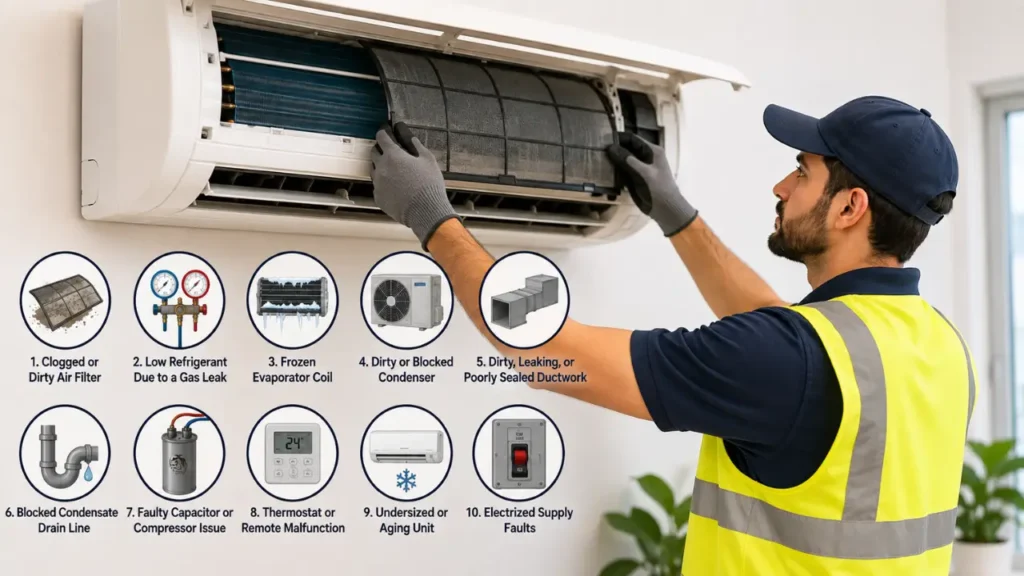
10 Common Causes of an AC Not Cooling in Dubai

1. A Clogged or Dirty Air Filter

There is no doubt about it; this is easily the commonest cause of an inefficient or overheated AC in the UAE. The function of the air filter is to screen out dirt before it gets to the indoor coil, and the air in Dubai is far dustier compared to other cities. When the filter is blocked, the efficiency of the airflow through the coil reduces significantly, making it difficult for the unit to extract heat from the indoors.

DIY fix: Rinse the filter using water and then put it back in place. This should be done after every 2-4 weeks in the peak summer months.

2. Low Refrigerant Due to a Gas Leak

If the air blown into the room is only slightly cool, you hear some hissing noise around either the indoor or outdoor unit, or there is a presence of frost on the copper refrigerant lines, insufficient refrigerant could be the cause. At this stage, it is important to understand that refrigerant is a sealed system fluid; it is not used up in any way in the normal functioning process of the AC unit.

Why a quick top-up isn’t a real fix: The most common inexpensive service performed in such cases includes simply adding some gas and sending the technician away. Not repairing the leakage will eventually lead to the AC blowing out warm air after a month or so, requiring the replenishing again.

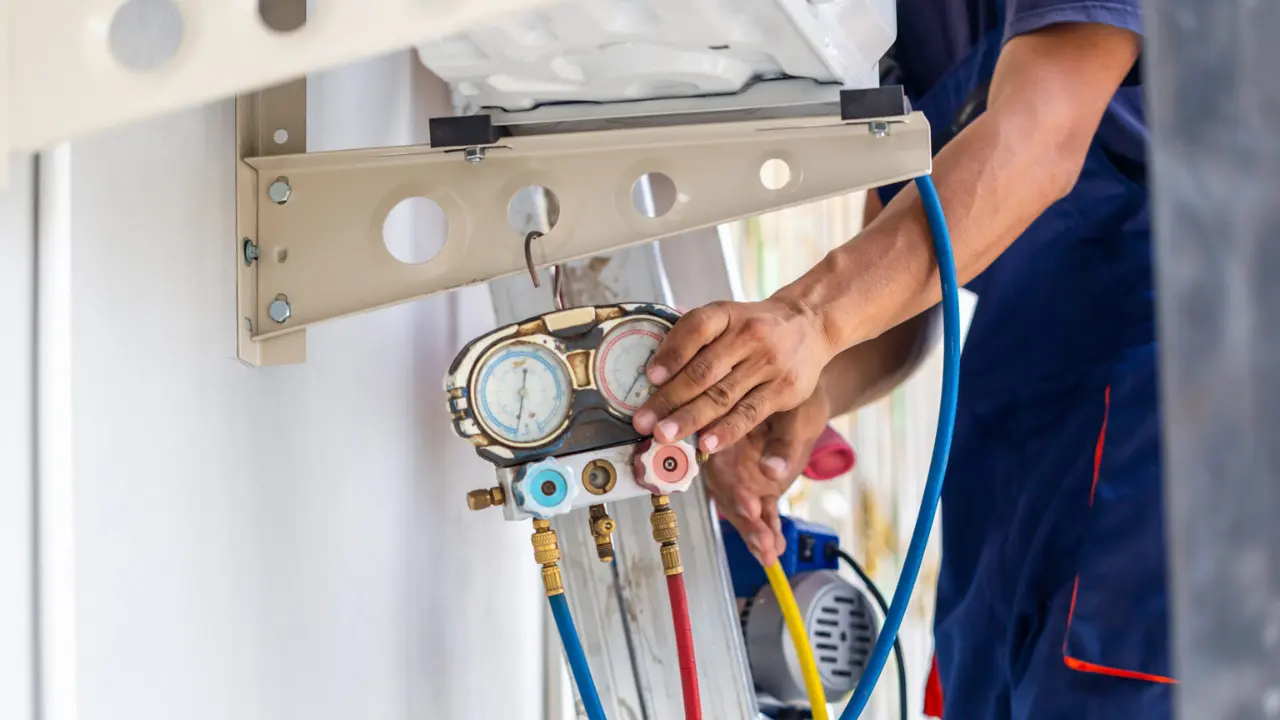
Fix: This is strictly a job for a licensed technician with leak-detection tools, a vacuum pump, and the right refrigerant type for your unit.

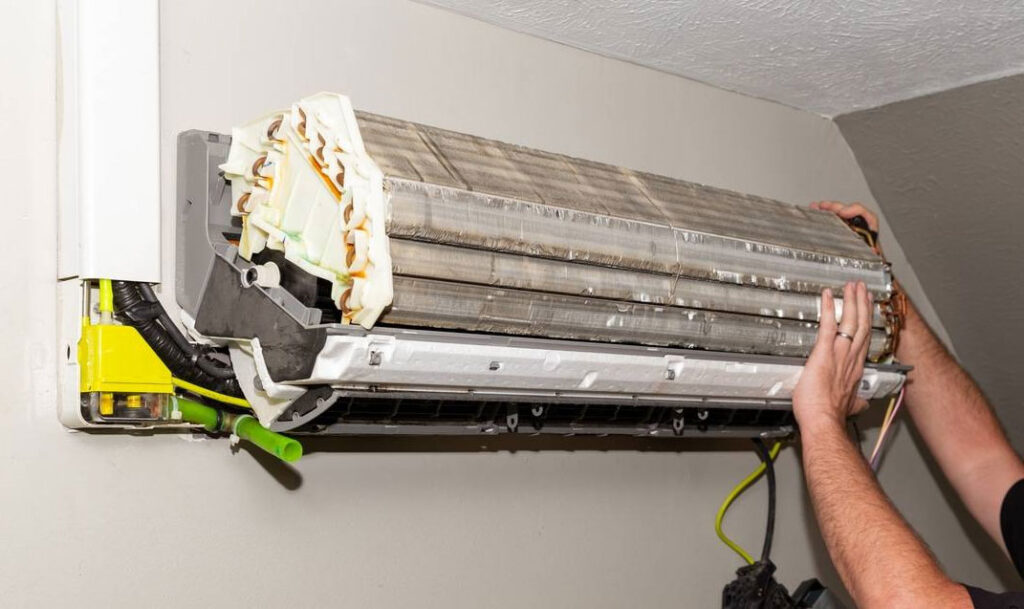
3. A Frozen Evaporator Coil

Opening the indoor unit to find an accumulation of ice in the coil or the copper lines means that the evaporator is frozen. When this occurs, the effectiveness of cooling is drastically reduced since ice is not a good conductor of heat. Freezing is typically a sign of another problem. It may be blocked airflow due to a clogged filter, or a low refrigerant level resulting in the coil getting below the freezing temperature.

DIY fix: Completely turn off the AC and place it in fan mode (or switch it off). The melting process will take several hours without intervention. Do not attempt to manually remove ice from the coil; you could damage the copper tubing. When the coil is melted, check the filter and determine if the problem still persists.

4. A Dirty or Blocked Condenser (Outdoor Unit)

The role of the outdoor condenser unit is to dispose of the heat collected by the air conditioning system from inside the home. In Dubai, the aluminum fins of the condenser get clogged very fast by dust, sand, and other particles present in the air, especially in systems that are installed near building sites or at the ground floor level. If the condenser unit is blocked, then it would not be able to disperse heat well, and the entire system will have to work more while producing less efficiency.

DIY fix: Rinsing the accessible fins using a garden hose (do not use high-pressure water jets since the fins could bend) is helpful. A full chemical coil clean, however, is best left to a technician as part of a proper AC service.

5. Dirty, Leaking, or Poorly Sealed Ductwork

Dust accumulation or leakage at the joints will cause a situation where certain rooms are cool while other rooms are still hot when you are using a central or ducted AC. Air leakage from the joints makes the cooled air seep into the ceiling void before it ever reaches your living space. While dust-clogged ducts restrict airflow the same way a dirty filter does, except spread across your entire home.

Fix: Duct inspection, sealing, and professional cleaning. You should not attempt this yourself, because ducts are located above false ceilings and can only be inspected and cleaned with special equipment.

6. A Blocked Condensate Drain Line

While your AC system will cool the air, it will pull a substantial amount of moisture from the air. In a city like Dubai where the atmosphere is humid, the system collects several liters of moisture daily. The collected moisture should be drained via the drain pan and drain line. Gradually, dust gets into the collected moisture and turns into sludge, leading to blockage of the drain line. Some modern systems come with a safety float switch that will shut off the system when the drain pan is filled with water. This is why a blocked drain line may be seen as “the AC stopped cooling” rather than visible water damage.

Symptoms: Dripping water from the indoor unit, wet patches on the ceiling, musty odor or lack of cooling for no obvious reason.

Fix: A drain line flush is quick and inexpensive for a technician, and far cheaper than repairing a water-damaged ceiling. That would be needed in case of an ignored drain problem.

7. A Faulty Capacitor or Compressor Issue

If your outdoor unit produces humming sounds, but the fan blade does not move, or your compressor fails to work and keeps clicking, then a faulty capacitor might be the reason for that. The capacitor provides a starting impulse of power to the compressor and fan motor. When the capacitor deteriorates, the motor has problems starting, and the result is a burden to the compressor, which is the most expensive part of your air conditioner.

Important safety note: The capacitor accumulates electrical charge even if the air conditioner is turned off and can give you a very painful shock. This is something only a professional technician can fix.

8. Thermostat or Remote Control Malfunction

In some instances, the AC system itself could be fine, but the control device giving it its operating instructions could have the problem. This is when there will be no room temperature conformity between actual temperature and the set temperature, when the AC turns on and off repeatedly in short bursts, or the display shows erratic behavior.

DIY fix:  First, replace the batteries in a wireless control or thermostat and make sure that the device is not installed in a peculiar place such as a window or sun-exposed area or right beside a supply vent, since this gives the device an incorrect temperature reading.

9. An Undersized or Aging Unit

If you find that your AC has never coped well during peak summer, works non-stop, and has a hard time in the largest or sunniest room. Then the cause of the problem may not be a fault, but just a lack of power for such a room. Air conditioning’s cooling power should correspond to the room size, ceiling height, window area, and sun exposure. Changes made to the room, like adding glass walls, opening partitions, or enlarging the room, can silently exceed the capacity of the installed unit. Also, units that are more than 10–12 years old have already lost some of their initial cooling capacity.

Fix: An accurate calculation done by a specialist will help you to understand what is necessary to fix, either duct change, new installation, or better insulation/shading.

10. Electrical Supply Faults

If your air conditioner continues to trip the breaker, causes your lights to flicker when the compressor turns on, or gives off a burning smell around the distribution panel, then it’s an electrical problem, not a mechanical one. The breaker is simply doing what it’s supposed to by stopping any fault in the home’s electrical system, be it faulty wiring, malfunctioning components sucking too much power, or a faulty connection.

Fix: Stop using the unit and call an AC technician immediately. Repeatedly resetting a breaker that keeps tripping is a fire risk, not a solution.

5 Quick DIY Checks Before You Call Anyone
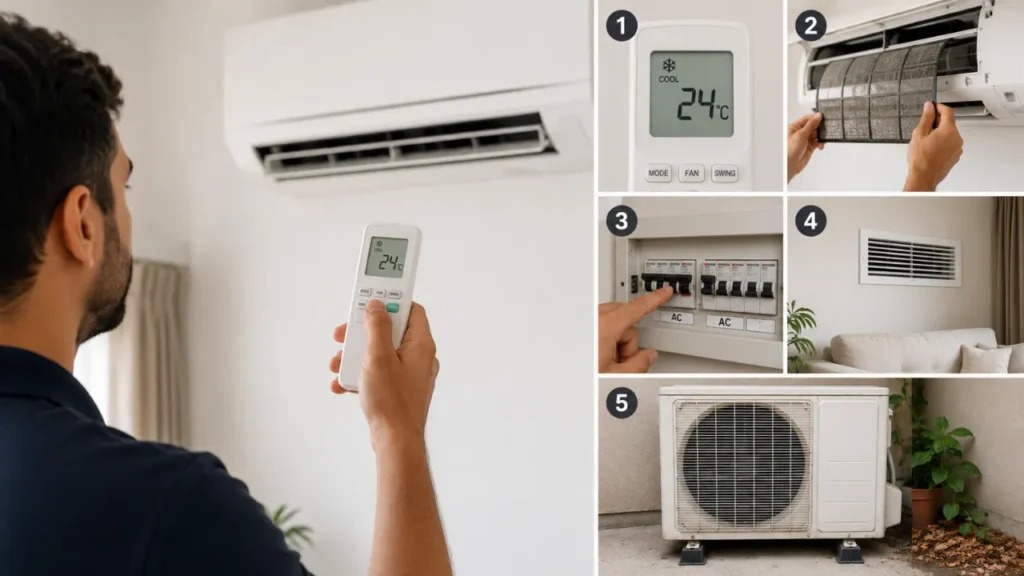
5 Quick DIY Checks Before You Call Anyone

Before assuming the worst, run through this two-minute checklist. It resolves a surprising number of “my AC isn’t cooling” calls without any tools or technical knowledge.

  1. Check the mode and temperature setting. It sounds obvious, but it’s the single most common false alarm. Confirm the remote or thermostat is set to Cool mode, not Fan, Dry, or Auto, and that the target temperature is a few degrees below the current room temperature. A stray tap on the remote, or a child playing with it, is often the entire “problem.”
  2. Pull out and inspect the air filter. Slide open the front panel of your indoor unit and remove the filter. If it’s grey, matted, or you can’t see light through it, that’s your answer. Rinse it under running water, let it air-dry completely, and put it back.
  3. Look at the breaker panel. Open your distribution board (DB) and check whether the AC’s breaker has tripped. You can reset it once. If it trips again immediately, stop; that’s a sign of a real electrical fault, not something to keep resetting.
  4. Check vents, returns, and furniture placement. Walk through the room and confirm that supply vents are fully open and that nothing- curtains, sofas, wardrobes, stacked boxes- is blocking the return air grille. Restricted airflow on either side chokes the whole system.
  5. Inspect the outdoor condenser unit. If you have access to your outdoor unit (on a balcony, rooftop, or ground-level pad), check that it’s running, that its fan is spinning, and that it isn’t buried in dust, sand, leaves, or stored items. The condenser needs open space around it to dump heat outside; a smothered unit simply can’t cool efficiently.

If one of these five checks solves the problem, you’ve saved yourself a callout fee. If cold air still isn’t coming through, one of the ten causes below is almost certainly responsible.

Typical AC Repair Costs in Dubai (2026 Estimates)

Costs vary by unit size, brand, and building type, but these are typical market ranges across Dubai to help you budget before booking a visit.

ServiceTypical Cost (AED)
Diagnostic/call-out visit100 – 200
Filter cleaning & basic service120 – 250
Refrigerant leak detection, repair & regas350 – 800
Frozen coil diagnosis & repair200 – 500
Condenser coil cleaning150 – 350
Duct cleaning (per system)400 – 900
Drain line flush100 – 200
Capacitor replacement150 – 300
Thermostat replacement200 – 400
Compressor replacement1,200 – 3,000+

Note: Prices are indicative and can vary depending on unit tonnage, brand, accessibility, and building type. Always ask for a fixed quote after diagnosis, before repair work begins.

How to Prevent This From Happening Again

Nearly every cause on this list is preventable with routine maintenance, done ahead of summer rather than in the middle of it:

  • Clean filters every 2–4 weeks during peak cooling months.
  • Schedule a professional AC service twice a year, ideally once before summer (March–April) and once in autumn, including coil cleaning, drain flushing, and a refrigerant pressure check.
  • Keep the outdoor condenser clear of dust, storage items, and anything within 30–50cm of its airflow path.
  • Set a sensible, steady temperature (around 23–24°C) rather than constantly adjusting it, this reduces strain on the compressor and capacitor.
  • Consider an annual maintenance contract (AMC) if you’d rather not track service dates yourself; a good AMC includes scheduled visits and priority response if something fails during peak summer.

When You Should Stop Troubleshooting and Call a Technician

DIY checks are genuinely useful for the first few causes on this list, the filter, the settings, a tripped breaker, blocked vents. But you should stop and call a professional immediately if you notice any of the following:

  • A hissing sound or visible frost on refrigerant lines
  • A breaker that trips again immediately after resetting
  • A burning smell anywhere near the unit or the DB panel
  • Water actively dripping or pooling near the indoor unit
  • The outdoor fan or compressor not starting despite power reaching the unit

Attempting to fix any of these yourself isn’t just unlikely to work; it can be genuinely dangerous, given the electrical currents and pressurized refrigerant involved.

Same-Day AC Repair in Dubai
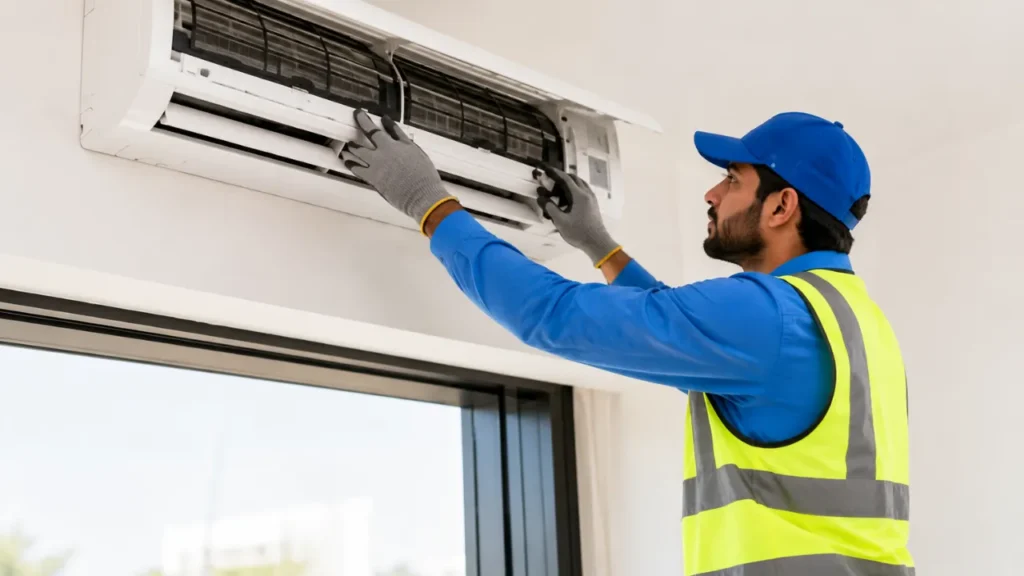
Same-Day AC Repair in Dubai

If you’ve worked through the checklist above and your AC still isn’t cooling, the smartest next step is a proper diagnosis rather than more guesswork. Our team at MD Technical Services LLC  handles emergency AC repair across Dubai, split units, ducted systems, and FCUs, with technicians who can usually reach you the same day, a clear price confirmed before any work starts, and no guesswork billing. Whether it’s a slow refrigerant leak, a failing capacitor, or a system that’s simply overdue for a proper service, we’ll find the actual cause and fix it once, not repeatedly.

Final Thoughts

An AC that won’t cool properly in Dubai’s heat is more than an inconvenience; left unresolved, small issues like a dirty filter or a minor refrigerant leak tend to escalate into bigger, more expensive repairs, from frozen coils to compressor damage. The good news is that the checks in this guide will resolve a large share of cases on their own, and for everything else, knowing exactly what’s likely wrong means you can describe the problem clearly, get a faster diagnosis, and avoid paying for guesswork.

If you’ve worked through the checklist above and your AC is still struggling to cool, it’s time to bring in a professional who can pinpoint the exact cause and fix it properly, the first time.

Frequently Asked Questions

Categories AC Tips

Complete Guide & Checklist For AC Maintenance in Dubai 2026

AC Maintenance in Dubai Complete 2026 Guide & Checklist

An air conditioner in Dubai is not only something that you use during certain seasons of the year. In any building in Dubai (a residential apartment, a villa, a shopping center, a restaurant, an office building, a hotel, etc.), an air conditioner is one of the most necessary systems. And once a malfunction occurs and the air conditioner ceases to cool properly, the consequences will soon appear.

Having worked for many years in Dubai in technical support, HVAC, MEP, renovations, and maintenance of properties in Dubai, one can say that almost all critical malfunctions happen unexpectedly. However, dirty filters, airflow blockages, blocked drains, contaminated condenser and evaporator coils, problems with refrigerant, damaged electrical contacts, and damaged elements and parts develop slowly.

Thus, for owners of property in Dubai, maintaining their air conditioners is not just about making the system cold. In a properly maintained air conditioner, the following should occur – consistent cooling of space, normal consumption of energy resources, correct airflow, reliable electrical work, effective dehumidification, and reliable work during the hottest days.

Here we discuss the whole process of AC maintenance, its frequency, what should be included in a professional service, warning signs of malfunctions, maintenance schedule, AC maintenance costs in the UAE, and whether to repair or replace an air conditioner.

Why Is AC Maintenance So Important in Dubai?

In most parts of the world, an air conditioner gets a seasonal break. In Dubai, it doesn’t. Summer temperatures regularly cross 45°C, and even “winter” months often call for cooling in the afternoon. That means your compressor, fan motors, and refrigerant system are working under near-constant load for most of the year.

A few Dubai-specific realities make routine maintenance non-negotiable:

  • Desert dust and sand. Fine particulate matter is constantly airborne in the UAE, and it settles fast on condenser coils, air filters, and fan blades, choking airflow within weeks of a clean.
  • Near-continuous runtime. Unlike temperate climates where an AC might run for four to five months a year, Dubai units can run 3,000+ hours annually, several times the wear and tear of a typical Western installation.
  • High humidity near the coast. Areas like Dubai Marina, Jumeirah, and Palm Jumeirah see elevated humidity that increases condensate load and raises the risk of mould and drain line blockages.
  • Villa and building design. Large glass facades, common in Dubai’s modern villas and towers, increase heat gain, meaning the AC has to work harder just to hold a set temperature.

The result of skipping maintenance in this environment isn’t a minor drop in comfort; it’s a 25–40% loss in cooling efficiency, a noticeably higher DEWA bill, and a much shorter lifespan for a system that should otherwise last twelve to fifteen years.

What Happens If You Skip AC Maintenance Service In Dubai

What Happens If You Skip AC Maintenance Service In Dubai

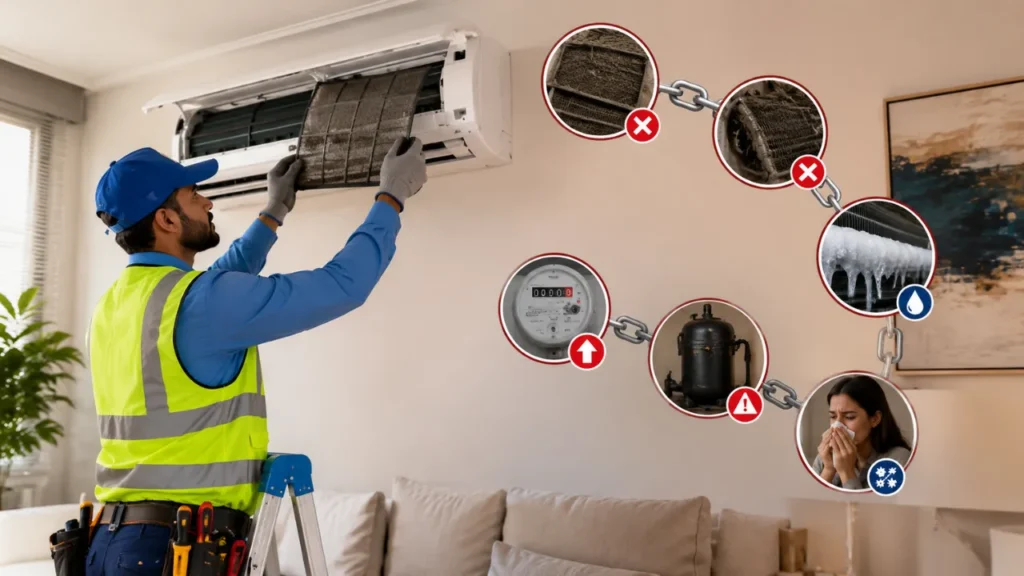
Filter blockage and lack of cleaning for a coil mean not only one issue but the beginning of a chain of consequences:

  1. Reduced airflow causes the need for additional runtime of the compressor until it reaches the desired temperature.
  2. This results in higher electricity consumption, which usually amounts to 10-15% and more.
  3. Ice formation on the evaporator coil, which subsequently melts and exceeds the capacity of the drain pan; this is what is causing 99.9% of our cases of ceiling water marks and “air conditioner leaking”.
  4. The additional load decreases the life of the compressor, which is the most costly air conditioner repair.
  5. Contaminated air continues being circulated through the air conditioning system and into your indoor environment, affecting all occupants of your home. This is especially dangerous if you have kids, elderly people in your family, or suffer from any kind of asthma or allergy.

All of this takes time and happens gradually, which is the reason why scheduled maintenance works much better than reacting to a visual symptom.

The Ideal AC Maintenance Schedule for UAE Homes

A well-maintained AC in Dubai needs attention at several different intervals, not just once a year. Here is the schedule our technicians recommend for residential systems:

Monthly:

  • Check and clean or rinse the air filter
  • Wipe down visible dust from air vents and grilles
  • Confirm the thermostat is reading and responding accurately

Every 3–4 months:

  • Deep clean of the indoor unit and blower
  • Drain line flush to prevent clogging
  • Visual inspection of the evaporator coil for dust or ice buildup

Twice a year (pre-summer and mid-summer):

  • Full professional AC tune-up
  • Refrigerant pressure check
  • Electrical connection and capacitor inspection
  • Outdoor condenser coil cleaning

Once a year:

  • Complete annual AC maintenance inspection
  • Full system performance report, including energy efficiency check
  • Ductwork inspection (for central and ducted split systems)

In a climate like Dubai’s, the “twice a year” service, ideally once just before summer in March or April, and again mid-season in July, is the single habit that prevents the vast majority of breakdown calls we handle.

The Complete AC Maintenance Checklist

Whether you’re doing a quick self-check or briefing a technician, this checklist covers everything that matters for a Dubai-based split, central, or ducted AC system.

Indoor unit:

  • Air filter cleaned or replaced
  • Evaporator coil checked for dust, mould, or ice
  • Blower fan cleaned and balanced
  • Airflow strength tested at each vent
  • Drain pan and drain line cleared of blockages

Outdoor unit:

  • Condenser coil rinsed clean of dust and debris
  • Surrounding area cleared of leaves, sand, and obstructions
  • Fan motor and blades inspected for wear
  • Compressor checked for unusual vibration or noise
  • Adequate clearance confirmed for proper ventilation

Full system check:

  • Refrigerant level and pressure tested
  • Electrical wiring, contactors, and capacitors inspected
  • Thermostat calibration verified
  • Ductwork checked for leaks or disconnected joints (ducted systems)
  • Overall energy efficiency assessed

What You Can Safely Handle Yourself

Not all needs require a technician. There are a few basic steps you can take on a regular basis to help protect your system from visit to visit.

  1. Switch off power: It is always advisable to turn off the AC at the isolator whenever you are performing any kind of maintenance, including even simple cleaning like washing the front panel.
  2. Maintain the filters: In the dusty environment of Dubai, this is the single most effective step you can take. Remove the filter, clean it with water, dry it completely, and reinstall it.
  3. Vents and grilles should remain free of dust: This can be accomplished by using a soft cloth or vacuum attachment to wipe away the accumulated dust.
  4. Outdoor condenser unit should also be inspected: In Dubai, it is usually sand, plastic bags, leaves, and construction dust that clog up the outdoor unit.
  5. Drain line check: If you see water building up next to the indoor unit, chances are the drain line is blocked.
  6. Keep track of how effectively your air conditioning is cooling: If a room that was cooling off quickly before suddenly takes longer to cool down, or if your DEWA bill is on the rise for no apparent reason, then you should take it as a warning signal.

Any further maintenance such as handling the refrigerant, testing electrical parts, working with the compressor, or thorough cleaning of the coils should always be done by a licensed professional. The handling of the refrigerant is specifically a regulated process and needs the use of special handling equipment.

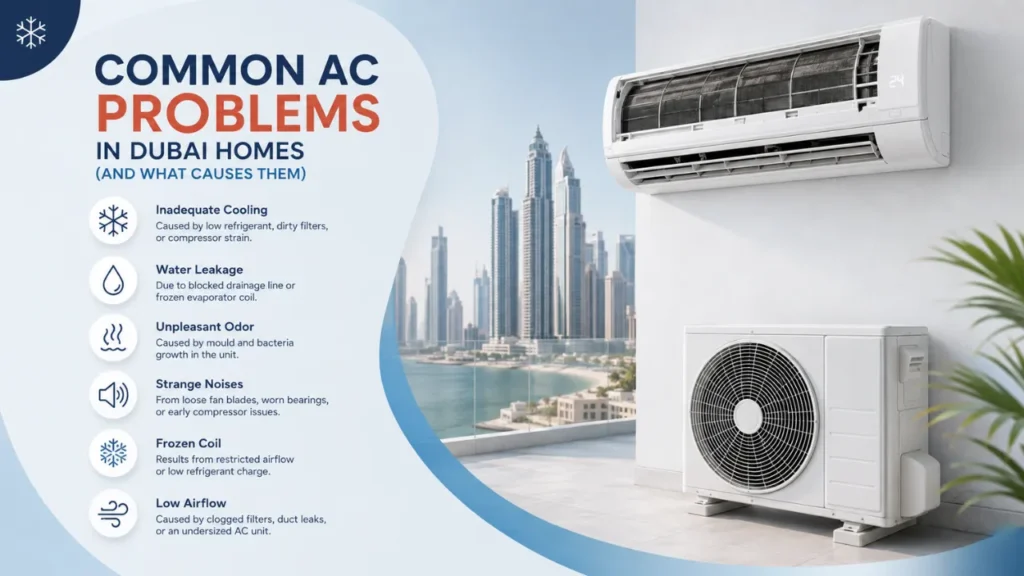
Common AC Problems in Dubai Homes (and What Causes Them)

Common AC Problems in Dubai Homes

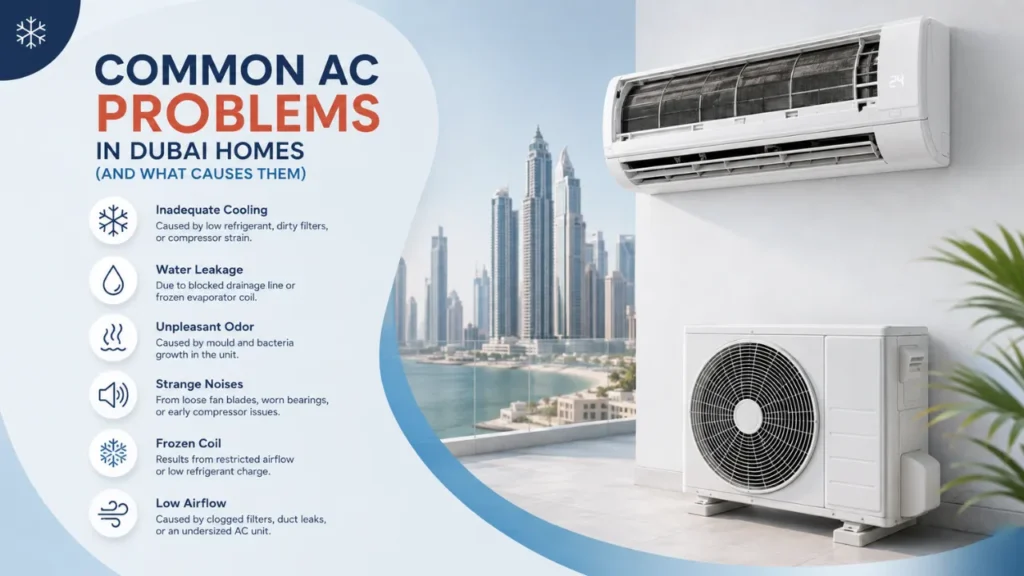
The few recurring problems experienced at all our clients’ properties include:

  1. Inadequate AC cooling performance as a result of lack of refrigerant, filter blockage, or early strain on the compressor.
  2. Water leakage from the indoor AC unit because of a blocked drainage line or because of the defrosting of the frozen evaporator coil.
  3. Smell of the unit due to the growth of mould and bacteria in the AC, especially at humid places such as Marina and JBR.
  4. Sound coming from the outdoor unit because of loosened fan blades or wear and tear in the bearing or signs of early compressor malfunction.
  5. Frozen coil, which results from restriction of airflow or low refrigerant charge.
  6. Low or insufficient airflow due to blockage of the filter, leakage from the duct, or an undersized air conditioner.

These problems become increasingly expensive the longer we leave them unattended. A simple refrigerant top-up or filter cleaning will cost us much less than a compressor replacement in six weeks.

Split AC vs. Central AC Maintenance in Dubai

Dubai flats and several villas are equipped with split ACs, whereas large villas and commercial buildings have ducted or central air conditioning systems. The maintenance process is somewhat different:

Split AC units have to be regularly checked for the functioning of indoor and outdoor units and for their coil cleaning, as well as checking the drain pipes, because each separate room is provided with the indoor unit, so several units should be checked instead of the central one.

The ducted or central AC systems have to be checked in terms of the same elements and, moreover, checked for the integrity of the ducts in terms of leakage, insulation problems, and even balanced flow distribution among several zones. One faulty element can affect the cooling of an entire floor; that is why such a system needs some kind of property-wide check.

A Few Extra Considerations For Inverter AC Maintenance

Inverter AC units, now standard in most new Dubai installations, are more energy-efficient but do need a few adjustments to standard maintenance:

  • Avoid frequent on/off cycling; inverter compressors are designed to run at variable speed continuously, not to be switched off and on repeatedly.
  • Keep filters extra clean, since inverter systems are more sensitive to airflow restriction.
  • Ensure a stable power supply, as voltage fluctuations can affect the compressor’s variable-speed drive.
  • Stick to the same twice-yearly professional tune-up schedule, with particular attention to the electronic control board during inspections.

Seasonal AC Care for the UAE Climate

Before summer (March-April): This is the most important maintenance period in the year. Pre-summer maintenance involves coil cleaning, checking the refrigerant level, flushing the drain line, and an electrical inspection. It will help to detect any problem that can arise before the hot season begins.

During the peak summer (June-August): When all the units are working throughout, it is advisable to do filter cleaning and a quick performance check.

Cold season (November-February): If there is any unit that has not been used frequently in this period, filter cleaning and drain line checking are recommended.

Commercial and Office AC Maintenance

Air-conditioning in offices, stores, restaurants, and hotels in Dubai works at higher loads compared to residential units, and a failure will have a direct impact on employees, customers, and earnings. A comprehensive maintenance program for a commercial air conditioning unit usually involves changing filters often, performing checks of the zoning system to make sure everything is balanced, and signing up for a preventive maintenance contract as opposed to repairing equipment after it has failed.

Signs Your AC Needs Professional Servicing Now

Call a technician rather than waiting for the next scheduled visit if you notice:

  • Noticeably weaker cooling than usual
  • A sudden jump in your DEWA electricity bill
  • Grinding, rattling, or clicking noises from either unit
  • Water leaking or pooling near the indoor unit
  • A musty or burning smell when the AC runs
  • Uneven cooling between rooms that used to feel balanced

Any one of these on its own might be minor. Two or more together usually mean the system needs attention before the next hot spell arrives.

The Real Cost of Preventive Maintenance vs. Emergency Repair

However, homeowners are often reluctant to spend money on a routine call due to its cost. Routine AC maintenance or thorough cleaning costs very little. The replacement of a compressor is the costliest repair an AC unit can require, and it usually means that for several months prior, there were issues with airflow, refrigerants, or electricity that could have been identified through routine maintenance. Thus, rather than being a cost, preventative maintenance is something that prevents costly repairs from happening at all.

How MD Technical Services LLC Approaches AC Maintenance in Dubai

MD Technical Services LLC is an AC maintenance company in Dubai that follows all the protocols for technical services, with an experienced team and a proper process involved. Our technicians conduct an inspection of indoor and outdoor ACs, perform cleaning of coils and filters, measure the pressure of refrigerant and electrical systems, flush the drain lines, and conduct a final system test. We provide our services in all types of ACs such as villas, apartments, offices, retail stores, hotels, and restaurants located in Dubai Marina, Downtown Dubai, Jumeirah, Business Bay, Palm Jumeirah, Al Barsha, and others, along with providing AMC services.

If your AC hasn’t been inspected in six months, don’t wait until your AC gives a problem; a pre-summer AC inspection will be easier and cheaper.

Final Thoughts

An air conditioner in Dubai isn’t a luxury appliance; it’s essential infrastructure, working harder here than almost anywhere else in the world. A consistent maintenance routine, clean filters, clear coils, checked refrigerant, and a professional inspection twice a year is the single most reliable way to protect your comfort, your electricity bill, and your investment in the system itself.

Ready to get your AC summer-ready? Contact MD Technical Services LLC for professional AC maintenance and annual maintenance contracts across Dubai, and let our team keep your cooling running smoothly all year round.

Frequently Asked Questions
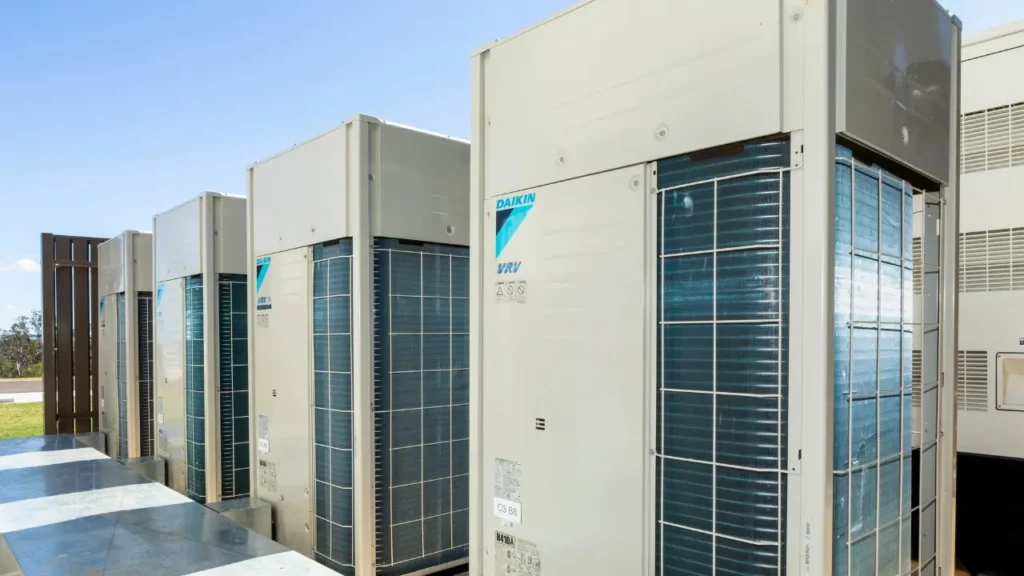
Categories AC Tips

AC Repair Dubai: 10 Common AC Problems, Causes & Professional Solutions

A Professional Repairing AC in Dubai

In Dubai, an air conditioner is hardly ever on a rest break during the summer months. During these months, an AC unit can operate non-stop every single day with temperatures exceeding 40°C, humidity, fine dust and sand, and a constant need for cooling inside premises. In all types of buildings and premises, including villas, apartments, office spaces, shops, and any kind of business premises, the following pattern of problems with AC units is encountered: an AC becomes inefficient, starts dripping water, develops an unusual sound, emanates a bad smell, or ceases operating when it is most required.

A significant observation in practice of installing HVAC systems and performing maintenance is the fact that an AC unit’s problem should not be assessed by its most apparent feature. An AC that “does not cool” can have problems such as a clogged filter, airflow issues, refrigerant leakage, a dirty condenser coil, electrical faults, and compressor issues. In the same way, leaking water from an indoor unit can be caused by a drainage issue or be associated with a frozen coil, inadequate insulation, and airflow restrictions. That is why effective AC repair in Dubai starts with proper diagnosis rather than simply replacing parts or adding refrigerant.

This guide will provide you with details about the various AC problems in Dubai that people commonly face, along with their causes, troubleshooting steps, and maintenance methods to avoid major repair issues in the future.

Why the Climate Of Dubai Is So Hard on Air Conditioners

To understand the reasons behind quick failures of AC units in the United Arab Emirates, it is better to take a look at the climate conditions that make the ACs break down faster than almost anywhere else in the world.

  1. Huge thermal load: If the temperature of the air outside is 45 to 50 degrees for months, then the compressor and condenser coil are working near maximum load almost non-stop, thus putting additional pressure on mechanical and electrical parts.
  2. High humidity: The humidity on the coasts of Dubai leads to a situation where a lot of condensation happens inside the unit, and it needs regular cleaning to prevent drainage problems.
  3. Sand and dust: Dust in Dubai accumulates on condenser fin tubes, clogs filters, and gets into electric contacts, resulting in loss of airflow and efficiency in just several weeks after servicing the system.
  4. Consecutive operation: While in temperate climates the use of an AC system is seasonal, in Dubai houses work all year long with the exception of winter, resulting in less downtime for all components.

This combination of environmental elements makes clear why even top-quality air conditioning systems by leading manufacturers require more maintenance than what their international service schedule would indicate.

The Top 10 AC Problems in Dubai And Their Causes

Top 10 AC Problems in Dubai And Their Causes

1. AC Not Cooling Effectively

Undoubtedly, it is our top concern during the summer months, from June to September. The unit operates, the fan turns, yet the coolness coming from it does not reach the temperature of cool air required by the hot weather outside.

Common causes:

  • Dirty or clogged air filters hindering the flow of air
  • Low amount of refrigerant due to slow leakage
  • A dirty condenser coil failing to release heat effectively
  • Faulty or improperly calibrated thermostat giving wrong signals

Professional solution:

The expert checks static pressure and airflow initially, changes or washes the filters, examines the coil for dirt, and measures the pressure of refrigerant using gauges. If there is little refrigerant, the system undergoes the test for locating the leak; it is repaired and charged again according to the manufacturer’s specifications. It should be noted that only such an approach to the problem gives long-lasting results; otherwise, adding some refrigerant without finding the leak is useless.

2. AC Leaking Water

Seeing water collected under an indoor unit or leaking from the ceiling is quite scary, but most of the time there is nothing major happening; it just has something to do with the draining.

Common causes:

  • The clogged condensate drain pipe, mostly due to algae, dust, or other debris
  • Damaged or dislocated drain pan
  • Frozen evaporator coils that melted and flooded the pan
  • Installation problem with the angle of the drain pipe, commonly found in old buildings

Professional solution:

The specialist will clean out the condensate drain pipe with a wet/dry vacuum or nitrogen flush, check the drain pan for any damage or misplacement, and will ensure that the unit is leveled so that water drains properly. In case the cause was frozen coils, the problem with airflow or refrigerant is solved first because just cleaning out the drain won’t help.

3. AC Blowing Warm Air

It’s not just annoying but infuriating when you have an AC system that is running at full tilt, the compressor working and the fan spinning, yet the output air seems to be no cooler than the room temperature air.

Common causes:

  • Damage or leakage in the refrigerant, thus weakening the heat absorption capacity of the system
  • A failing or damaged compressor
  • Electrical problems, such as a tripped capacitor and damaged wiring
  • Soiled outdoor condenser failing to release heat

Professional Solution:

Electrical testing (capacitors, contactors, wiring) and a complete check on the refrigerant pressure follow a diagnosis of the problem. One of the more costly repairs is that of a weak or bad compressor. Experienced technicians always factor in the cost of repairs versus the age of the system before making suggestions for repair or replacement of the compressor or even the entire AC system.

4. Strange Noises: Rattling, Buzzing, Grinding, or Squealing

All air conditioners make some noises during operation, but when the tone changes, or a new rattling, buzzing, or grinding noise occurs, it means that the AC wants to tell you about the existing problems.

Common causes:

  • Loose panels, screws, or mounting brackets
  • Dust, leaves, sand, or little stones inside the outdoor fan
  • Motor and fan bearings that wear out
  • Broken compressor – this problem often is accompanied by a loud humming noise

Professional solution:

The technician performs the troubleshooting process, operating indoor and outdoor units separately. He tightens all the fasteners, removes all the debris, and examines bearings and motor mounts. The worn bearings and fan motors are replaced, not just oiled, because the temporary fix of the failing motor leads to its burnout during one season.

5. High Indoor Humidity Despite the AC Running

When you feel humidity in your house even when you are running your AC, then your AC isn’t working effectively because AC not only cools your room, but the main purpose of AC is moisture removal.

Common causes:

  • Oversized AC that makes the room cold quickly but stops before removing the moisture
  • Condensate drain pipe clogged so that moisture is not being removed properly
  • Dirty evaporator coils reduce the effectiveness of the dehumidification process
  • Wrong settings of the thermostat

Professional Solution:

The technician will check if the capacity of the AC is proportional to the size of the room because the common problem in villas is that AC is installed in a generic manner regardless of its capacity needed for the room.

6. Short Cycling (AC Turning On and Off Repeatedly)

Short cycling occurs when the compressor turns on for several minutes, then off, and turns back on again. This process not only uses up energy but also creates considerable strain on the compressor.

Common causes:

  • Dirty air filters that reduce airflow and affect thermostat readings
  • The installation of the thermostat near a heat source or directly under the sun
  • Oversized unit in the room
  • Problems with the refrigerant resulting in pressure imbalance

Professional solution:

Filters get cleaned or replaced, the thermostat gets checked for accuracy and location, and refrigerant levels are examined. In case of the oversizing problem, the specialist will advise you to perform a load calculation in the future.

7. Frozen Evaporator Coils

If you notice ice buildup on the evaporator coils, either visible or within the unit itself, it’s almost always an indication that the balance between airflow and refrigerant is not correct.

Common causes:

  • A restriction in the airflow caused by clogged filters or blocked vents
  • Lack of refrigerant in the system
  • Defective fan or motor

Professional solution:

The unit needs to be switched off until the ice melts (it should never be scraped since this can damage the coils), new filters are installed, the air passages are cleaned, and refrigerant pressure is checked. In most cases of frozen evaporators, the compressor will get damaged when running without figuring out what caused it to freeze, which is one problem for which DIY solutions don’t really apply.

8. Bad Odors From the AC Vents

A musty, sour, or burning odor coming out of the vents is not only annoying but usually a sign of biological contamination or a problem with the electricity.

Common causes:

• Mold or bacteria growing in the moist coils or drain pan

• Buildup of dust and other material in the ducts

• Burning wires or overheated component (this is more of an “electrical” odor)

Professional solution:

Musty odors are dealt with by cleaning the coils, drain pan, and ducts, possibly along with the use of UV and antimicrobial treatments. The burning odor is considered an urgent matter and the system is turned off to check the electrical components, as it may be a sign of a fire hazard.

9. High Electricity Bills Without a Clear Reason

The people living there will only notice that their AC unit is not functioning properly when their DEWA bill comes in much higher than normal.

Common causes:

  • Dirty coils and filters requiring the compressor to work overtime
  • Either an old system working ineffectively
  • Underfilled refrigerant leading to increased time spent running
  • Improper scheduling of the thermostat

Professional solution:

An efficiency test, which covers the filters, coils, refrigerant levels, and energy consumption, will normally tell you what the problem is. In some instances, simply having your AC unit maintained properly can lower your bills significantly.

10. AC Unit Won’t Turn On At All

The worst-case situation would be having temperatures at 43°C while the unit won’t turn on.

Common causes:

  • Tripped circuit breaker or a blown fuse
  • Defective thermostat or thermostat batteries have died out
  • Bad capacitor or contactor
  • Locked-up compressor due to electrical stress

Professional solution:

Electrical testing comes first; breakers, fuses, capacitors, and contactors are checked one by one. Should the compressor fail, the professional gives an honest evaluation of repairing vs. replacement price – as in many cases, replacing a compressor for an old system will cost almost as much as a new one.

How To Prevent AC Problems

Responding to problems is costly. But prevention is much more cost-effective. Based on our observations during hundreds of visits a year, these practices will make the greatest measurable impact:

  • Two preventative maintenance visits per year, preferably one before peak summer months (March–April) and another one after (October), not when problems arise.
  • Twice a month or even monthly filter cleaning and replacement period because dust level in the Dubai environment clogs filters way sooner than it usually does in other regions.
  • Outdoor condenser should be free of sand, leaves, and debris and not obstructed by anything that may affect the airflow.
  • Periodic flushing of the condensate drain line to avoid the accumulation of algae and dust causing leakage.
  • Once a year, professional coil and duct cleaning, as visible dust on the outside is only a part of accumulated dirt.
  • Maintaining the temperature at realistic levels and not cooling the house unnecessarily to avoid longer operation of the compressor.
  • Making adjustments at the first signs of problems and not procrastinating, as a minor problem now may result in a compressor breakdown soon.

DIY Checks vs. When to Call a Professional

There is only a short list of things that can be safely done by DIY enthusiasts: changing a disposable filter, cleaning the outdoor unit from visible debris, and making sure that the thermostat has power and the proper settings. Otherwise, AC repairs in Dubai should be performed by a certified HVAC technician since:

  • The manipulation of refrigerant is possible only with a certificate and special equipment, while improper use of it is both illegal and dangerous.
  • Electrical issues are associated with fire and electric shock hazards in the system with high-voltage parts.
  • Identifying the true cause of a malfunction instead of its symptoms will prevent the same issue from arising again soon.
  • The warranty conditions of many AC models sold in the UAE include professional maintenance only.

The basic principle is that if you need to open electrical panels or work with refrigerant, you should better contact a professional.

Choosing the Right AC Repair Company in Dubai

Not all the service people coming in with their tool kits have the same level of expertise. In your hunt for an AC repair Dubai company, seek out one which:

  • Is properly licensed and insured, meaning that it is allowed to conduct business in Dubai
  • Provides clear quotations before beginning any work, as opposed to giving vague estimates
  • Has experience servicing different brands of air conditioners because Dubai houses air conditioners made by LG, Samsung, Daikin, Gree, Carrier, O General, and many others
  • Provides a written warranty for parts and services so that if the problem appears again soon after, you know you are protected

In addition, the right people would explain the problem and give reasons why they think it happened.

Conclusions

Air conditioning in Dubai is no luxury; it is a necessity, and considering the weather conditions in Dubai- heat, humidity, and dust- all well-installed systems require regular, competent servicing in order to continue working properly. All of the usual symptoms of AC malfunctions in Dubai, such as weak cooling, water leaks, unusual noises, hot air blowing out, increased humidity or electricity bills, can be attributed to only several main causes – dirtiness of parts, problems with the refrigerant, poor drainage, or electrical wear and tear. Being able to recognize the symptoms, regularly servicing the AC unit, and being aware of when to call an expert from AC repair Dubai is what will allow your system to work without problems for 15 years instead of breaking down every summer. A professional AC repair in Dubai should therefore be founded upon the principle of diagnosis.

This is something that MD Technical Services LLC ought to aim for. The idea is simply to diagnose the problem, understand what caused it, conduct the right kind of repair, and ensure that your AC is working properly again. This could be an AC not cooling, leaking water, inadequate airflow, unusual sounds, refrigerant issues, or other types of AC malfunctions.

If your air conditioner displays any of the symptoms described above, do not wait until you experience its failure in the middle of a heat wave – a timely inspection will most likely be cheaper than a repair of a breakdown.

Frequently Asked Questions
How long can an AC system serve in Dubai? 

Well-maintained systems last around 10-15 years in Dubai. However, units that are not serviced or are not maintained regularly tend to face serious problems after 5-7 years due to the hot climate and dusty environment.

How often do I need to maintain my AC unit in Dubai? 

Twice a year is recommended, just before and after summer.

Why does my AC give off a bad odor when it starts? 

If your AC smells like mold, then there might be an infestation of bacteria and mold in the coils, drain pan, or even in the ducts of your AC system. Otherwise, the bad smell will imply an electrical problem with your AC system.

Is it okay for the AC to have minor leakage of water in Dubai’s humid weather? 

Small amounts of condensation are fine, but leaking means a clogged drain pipe or some other problem that needs to be sorted out before it causes ceiling, wall, or floor damage.

Can I simply top up the refrigerant in my AC if it does not cool? 

No. Handling of refrigerant needs certification, and topping it up without fixing the cause of leakage is a temporary solution anyway.

Categories AC Tips

AC Gas Refilling Charges in Dubai – Cost Comparison and Complete Guide for 2026

AC Gas Refilling Charges in Dubai

Air conditioning is essential in Dubai’s hot climate. When your AC stops cooling properly, it often needs gas refilling near you. This guide explains everything about AC gas refilling charges in Dubai for homes and businesses.

AC Gas Filling Charges in Dubai

AC gas refilling costs vary based on several factors. Understanding these charges helps you budget for maintenance and avoid overpricing.

AC Gas Filling Charges for Residential Properties in Dubai

Home AC gas refilling is common in Dubai. Most houses need this service once or twice a year. The cost depends on your AC size and type.

Split AC units in homes usually cost between AED 150 to AED 300 for gas filling. Window AC units are slightly cheaper, ranging from AED 120 to AED 250. The price includes checking for leaks and adding the right amount of gas.

Get Your AC Refilled Today

AC Gas Filling Charges for Commercial Properties in Dubai

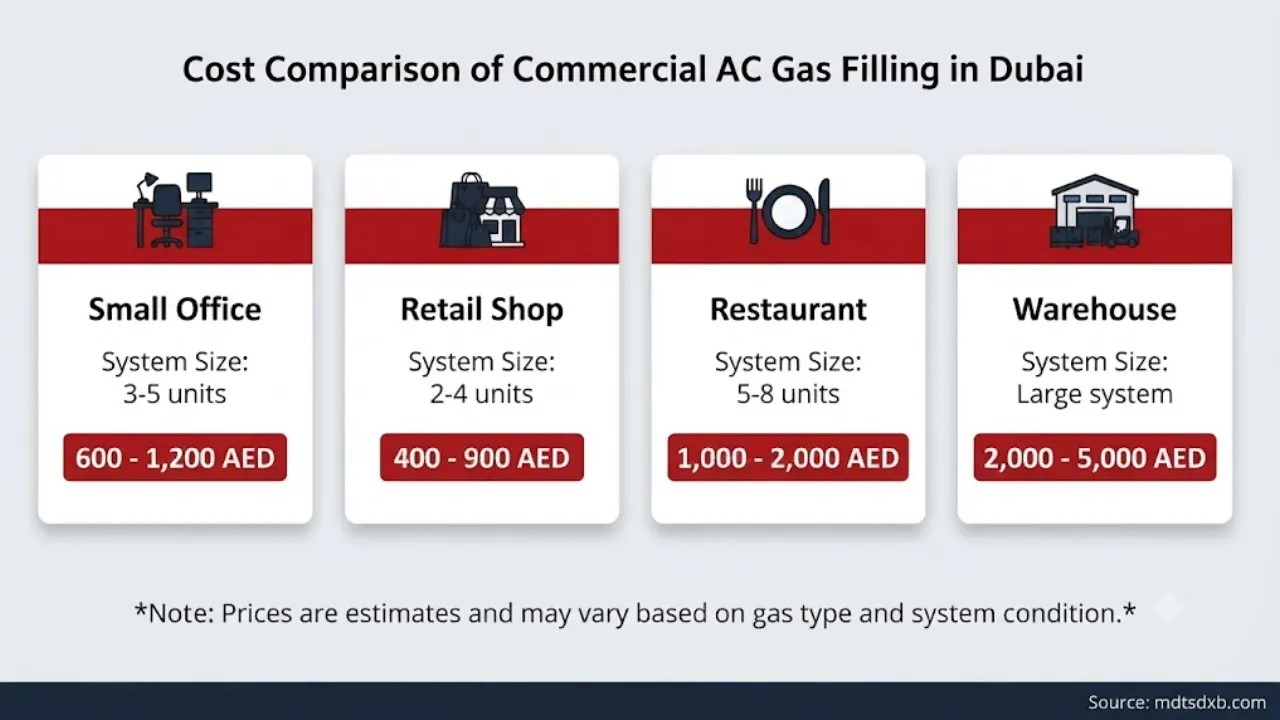
Commercial properties have larger cooling systems. Offices, shops, and restaurants need more gas and take longer to service. Commercial AC gas filling costs more than residential work.

Large offices can expect to pay AED 400 to AED 800 per unit. Retail stores with multiple AC units might pay AED 300 to AED 600 per system. Restaurants often pay similar prices depending on their setup.

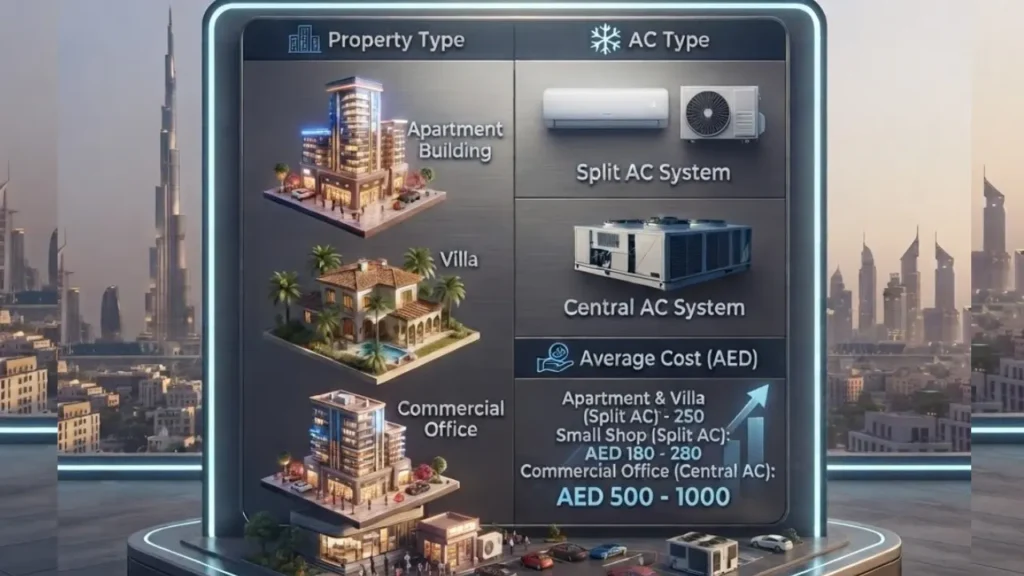
Average AC Gas Filling Cost in Dubai

Average AC Gas Filling Cost in Dubai

These prices are typical across Dubai. Actual costs may vary by location and service provider.

Factors Affecting AC Gas Filling Charges in Dubai

Several things affect how much you pay. AC size is the main factor. Bigger units need more gas and cost more to fill.

The type of gas also matters. Newer gases like R32 cost more than older types. Your location in Dubai can change prices too. Areas far from the city center may have higher service charges.

If your AC has a leak, you pay extra for repairs. Finding and fixing leaks adds AED 100 to AED 300 to the total cost. The time of year matters as well. Summer months are busier, so some companies charge more.

AC Gas Refilling Cost Per Ton in Dubai

AC capacity is measured in tons. One ton equals 12,000 BTU of cooling power. Most home units are 1 to 2 tons.

AC gas refilling for a 1-ton unit costs AED 150 to AED 200. A 1.5-ton unit costs AED 180 to AED 250. Two-ton units range from AED 220 to AED 300. Larger commercial units of 3 to 5 tons can cost AED 400 to AED 700.

AC Gas Filling Charges With Leak Repair in Dubai

Leaks are common in older AC systems. If gas keeps running out quickly, you likely have a leak. Fixing leaks before refilling is important.

Simple leak repairs cost AED 100 to AED 200. Complex repairs with pipe replacement can cost AED 300 to AED 500. Most technicians find leaks using special detection tools. Total cost with leak repair and gas filling ranges from AED 300 to AED 800.

Residential AC Gas Refilling in Dubai

Residential AC Gas Refilling in Dubai

Home AC maintenance keeps your family comfortable. Regular gas filling ensures your system works well during hot months.

AC Gas Refilling for Apartments in Dubai

Dubai apartments mostly use split AC units. These units are wall-mounted and easy to service. Apartment AC gas filling takes about 30 to 45 minutes per unit.

Studio apartments with one or two units pay AED 150 to AED 300 total. Larger apartments with three to four units pay AED 450 to AED 900. Many apartment owners schedule annual maintenance to avoid summer problems.

AC Gas Filling for Villas in Dubai

Villas have more AC units than apartments. A typical villa has 5 to 10 split units or a central system. Gas filling for villas takes longer and costs more.

A villa with 5 split units costs AED 750 to AED 1,500 for complete gas filling. Central AC systems in villas cost AED 800 to AED 2,000 depending on capacity. Villa owners often get package deals from service companies.

Split AC Gas Filling Charges for Residential Use

Split ACs are the most common type in Dubai homes. They have an indoor and outdoor unit. Split AC gas filling is straightforward and quick.

Standard 1.5-ton split units cost AED 180 to AED 250. Inverter split ACs might cost slightly more due to different gas types. The technician checks pressure, adds gas, and tests cooling performance.

Window AC Gas Filling Charges for Homes

Window ACs are less common now but still used in older buildings. These units are simpler than split systems. Gas filling is usually cheaper.

Window unit gas filling costs AED 120 to AED 200. The process is faster because everything is in one box. Most window ACs use older gas types that cost less.

Cost Comparison of Residential AC Gas Filling in Dubai

Service TypeBasic CostWith Leak CheckWith Leak Repair
Split AC (1 ton)AED 150AED 180AED 300
Split AC (1.5 ton)AED 200AED 230 AED 350
Split AC (2 ton)AED 250AED 280AED 400
Window ACAED 150AED 180AED 280

Always ask for leak checking. It helps prevent repeat gas filling in a few weeks.

Request Your Free BOQ Quote

Same Day Residential AC Gas Filling Service in Dubai

Many companies offer same-day service. This is helpful during Dubai’s hot summer months. You can book in the morning and get service by evening.

Same-day service might cost AED 20 to AED 50 extra. Most reputable companies provide this without extra charges. Weekend service is also available but may have small additional fees.

Emergency AC Gas Filling for Homes in Dubai

AC breakdown during summer is an emergency. Many companies offer 24-hour emergency service. Emergency AC gas filling costs more than regular appointments.

Emergency service charges add AED 50 to AED 100 to normal prices. Late night calls after 10 PM cost the most. Despite higher costs, emergency service is worth it for comfort and safety during extreme heat.

Time Required for Residential AC Gas Filling

A single split AC takes 30 to 45 minutes for gas filling. This includes checking pressure, adding gas, and testing. Multiple units take proportionally longer.

Leak detection adds 15 to 30 minutes per unit. Complete service for a 3-bedroom apartment takes about 2 to 3 hours. Technicians usually complete villa work in one visit lasting 3 to 5 hours.

Commercial AC Gas Filling in Dubai

Commercial AC Gas Filling in Dubai

Business AC systems are larger and more complex. They need professional handling and regular maintenance.

AC Gas Filling for Offices in Dubai

Office AC systems run long hours daily. They need more frequent maintenance than home units. Office AC gas filling is scheduled during off-hours to avoid disruption.

Small offices with 3 to 5 units pay AED 600 to AED 1,200. Medium offices with 10 to 15 units pay AED 1,500 to AED 3,000. Large corporate offices often have maintenance contracts that include gas filling.

AC Gas Filling for Shops and Retail Stores

Retail spaces need good cooling to keep customers comfortable. Shop AC units work hard during business hours. Regular gas filling maintains performance.

Small shops pay AED 300 to AED 600 for gas filling. Medium-sized stores pay AED 700 to AED 1,200. Large retail spaces with many units pay AED 1,500 to AED 3,000. Weekend service is common for retail since they cannot close during weekdays.

AC Gas Filling for Restaurants and Cafes

Restaurant kitchens get very hot. AC systems work extra hard in these spaces. Restaurant AC gas filling is needed more often than other businesses.

Small cafes pay AED 400 to AED 800 for complete service. Medium restaurants pay AED 900 to AED 1,500. Large restaurants with dining halls and kitchens pay AED 2,000 to AED 4,000. Many restaurants schedule maintenance during closed hours or slow periods.

AC Gas Filling for Warehouses and Industrial Units

Warehouses have large spaces with big AC systems. Industrial cooling is different from regular commercial work. These jobs need specialized technicians.

Small warehouse units cost AED 800 to AED 1,500 per system. Large industrial AC systems cost AED 2,000 to AED 5,000 or more. Gas filling takes several hours and may require multiple visits for very large facilities.

Commercial HVAC Gas Filling Service in Dubai

HVAC systems are complete climate control systems. They handle heating, cooling, and ventilation. Gas filling for HVAC is more technical than simple AC work.

HVAC service includes checking all components and systems. Costs range from AED 1,000 to AED 5,000 depending on system size. Annual maintenance contracts often include HVAC gas filling at discounted rates.

Commercial HVAC Gas Filling Service in Dubai

Commercial customers often negotiate package rates for multiple visits per year.

Same Day Commercial AC Gas Filling in Dubai

Businesses need fast service to avoid losing customers or productivity. Same-day commercial service is widely available. Many companies prioritize business clients.

Most commercial AC service providers respond within 4 to 6 hours. Same-day service for businesses usually has no extra charge. Priority service guarantees response within 2 hours for an additional AED 100 to AED 200.

24 Hour Commercial AC Gas Filling Service

Restaurants, hotels, and hospitals need 24-hour service availability. AC failure at night or weekends requires immediate response. Round-the-clock service is essential for these businesses.

After-hours commercial service costs AED 100 to AED 300 extra. Many businesses have annual contracts that include free emergency calls. Hotels and hospitals usually have dedicated service agreements with guaranteed response times.

Time Required for Commercial AC Gas Filling

Small commercial spaces take 2 to 3 hours for complete service. Medium businesses need 3 to 5 hours. Large facilities may require a full day or multiple visits.

The time includes inspection, pressure testing, leak detection, gas filling, and performance testing. Technicians often work in teams for large commercial projects to reduce downtime.

AC Gas Types Used in Dubai

Different AC models use different refrigerant gases. Understanding gas types helps you know what your system needs.

R22 AC Gas Filling Charges in Dubai

R22 is an older gas type. Many ACs installed before 2015 use R22. This gas is being phased out worldwide due to environmental concerns.

R22 gas filling costs AED 150 to AED 250 per unit. The gas is becoming harder to find and more expensive. Some technicians recommend upgrading to newer gas types for better efficiency.

R32 AC Gas Filling Charges in Dubai

R32 is a newer, more efficient gas. Many modern AC units use R32. It cools better and is better for the environment than older gases.

R32 gas filling costs AED 180 to AED 300 per unit. The higher price reflects better quality and efficiency. R32 systems need less gas refilling over time, saving money long-term.

R410A AC Gas Filling Charges in Dubai

R410A is common in Dubai AC systems. It replaced R22 in most new installations. This gas performs well in hot climates like Dubai.

R410A gas filling costs AED 160 to AED 280 per unit. It is widely available and works efficiently. Most AC brands use R410A as their standard refrigerant.

Difference Between AC Gas Types Used in Dubai

Gas TypeEfficiencyEnvironment ImpactCost LevelAvailability
R22ModerateHigh impactMediumDecreasing
R32HighLow impactHigherGood
R410AGoodMedium impactMediumExcellent

Never mix different gas types in one AC system. Always use the gas specified by the manufacturer.

Best AC Gas for Dubai Climate

Dubai’s extreme heat requires efficient cooling. R32 and R410A work best in high temperatures. They maintain cooling even when outside temperature exceeds 45°C.

R32 is the best choice for new installations. It uses less energy and cools faster. R410A is reliable and widely supported by technicians. Both gases handle Dubai’s climate better than older R22.

AC Gas Filling Time and Process

Understanding the process helps you know what to expect during service.

AC Gas Filling Process Used in Dubai

Technicians follow standard steps for AC gas filling. First, they check if gas is actually low. Than they measure ac gas pressure chart in the system using gauges.

Next, they inspect for leaks using detection equipment. If leaks are found, they must be repaired before adding gas. After repairs, they vacuum the system to remove air and moisture.

Finally, they add the correct amount of gas by weight. They test the AC to ensure proper cooling. The entire process ensures your AC works efficiently and safely.

Time Required for AC Gas Filling in Residential Units

Single residential AC units take 30 to 45 minutes without leak issues. With leak detection and minor repairs, expect 60 to 90 minutes per unit.

Complete home service for 3 to 4 units takes 2 to 3 hours. Villas with 6 to 8 units need 4 to 5 hours. Technicians usually complete residential work in one visit.

Time Required for AC Gas Filling in Commercial Systems

Commercial systems take longer due to size and complexity. Small business units take 2 to 4 hours for complete service. Medium-sized commercial systems need 4 to 6 hours.

Large commercial or industrial systems may need 8 to 12 hours or multiple visits. Complex HVAC systems require full-day service appointments. Technicians schedule commercial work to minimize business disruption.

How Often AC Gas Refilling Is Required in Dubai

Well-maintained AC systems should not need frequent gas filling. Gas does not get used up; it only escapes if there are leaks. Properly sealed systems can go years without refilling.

If your AC needs gas every few months, you have a leak problem. Most Dubai homes need gas filling every 2 to 3 years if no leaks exist. Commercial systems need checking annually due to heavy use.

Best Time of Year for AC Gas Filling in Dubai

Schedule AC gas filling near me before summer starts. March and April are ideal months. Technicians are less busy and prices may be lower.

Avoid waiting until May or June when demand peaks. Emergency service during peak summer is expensive and has longer wait times. Annual maintenance in spring prevents summer breakdowns.

Book a Fast AC Inspection

Conclusion

AC gas refilling charges in Dubai vary based on property type, AC size, and gas type. Residential units typically cost AED 150 to AED 300, while commercial systems range from AED 400 to AED 1,000 or more. To ensure your system runs efficiently and to avoid costly emergency repairs, it is essential to hire the Best AC Service in Dubai.

Beyond AC maintenance, a well-functioning home requires integrated care. If you are renovating your space, our Interior Fit-Out Services can transform your property, while our Joinery Works provide custom, high-quality finishes. For property upkeep, we also offer professional Water Heater Services, Painting Services, and even Swimming Pool Services to keep your villa in peak condition.

Regular maintenance and leak prevention save money long-term. Schedule service before summer for best availability and pricing, and always choose certified technicians who use proper equipment and genuine refrigerant gases.

Frequently Asked Questions
Categories AC Tips

Split AC Repair in Dubai | Reasons and Solutions

Split Ac Repair Guide

Why Dubai Weather Is Hard on Air Conditioners

High Heat Makes Compressors Work Harder

Sand and Dust Block Important Parts

Humidity Adds Extra Load

What Makes the need of Split AC Repair

Running Without Breaks

Dirty Filters and Coils

Poor Air Movement

Skipping Regular Service

Early Warning Signs Your AC Needs Help

Weak or Uneven Airflow

Strange Sounds

Bad Smells When AC Runs

Water Leaking

Simple Checks You Can Do at Home

Look at Your Air Filters

How to clean:

Check Your Thermostat

Inspect the Outdoor Unit

Test the Power Supply

When to Call a Professional

Cooling Does Not Improve

You Suspect Gas Leaks

Electrical Issues Appear

Compressor Makes Loud Noise

How Regular Care Prevents Big Repairs

Why Filter Cleaning Matters Most

Professional Service Schedule

Daily Habits That Help

What Happens During Professional Repair

Complete System Check

Safe Repairs

Maintenance Tips After Repair

Cost Comparison Table

Long Term Effects of Ignoring Maintenance

Higher Electricity Bills

Shorter AC Lifespan

Poor Air Quality

Bigger Repair Costs

Why Dubai Heat Changes Everything

Problems Grow Quickly

Peak Summer Challenges

Best Time for AC Service

Before Summer (March-April):

During Summer (May-September):

After Summer (October):

Frequently Asked Questions

How often should I clean AC filters in Dubai?

Clean filters every 2 to 4 weeks during hot months because dust builds up very quickly.

Can dust alone damage my AC?

Yes, heavy dust blocks airflow, causes overheating, and damages the compressor over time.

Is weak cooling always a gas problem?

No, dirty filters and blocked coils are more common causes than low refrigerant.

Are AC water leaks serious?

Yes, maintenance catches small issues early and prevents expensive breakdowns.

Does regular maintenance reduce repair costs?

Yes, maintenance catches small issues early and prevents expensive breakdowns.

What temperature should I set my AC to?

Set your AC to 24°C for good comfort and lower electricity bills.

How long should a split AC last in Dubai?

With proper care, split AC units last 10 to 12 years in Dubai’s climate.

Why does my AC smell bad?

You can clean filters and clear space, but deep cleaning needs professional tools.

What is the biggest cause of AC failure in Dubai?

Dirt and dust blocking filters and coils cause most AC problems here.

Conclusion