



In Dubai, an air conditioner is hardly ever on a rest break during the summer months. During these months, an AC unit can operate non-stop every single day with temperatures exceeding 40°C, humidity, fine dust and sand, and a constant need for cooling inside premises. In all types of buildings and premises, including villas, apartments, office spaces, shops, and any kind of business premises, the following pattern of problems with AC units is encountered: an AC becomes inefficient, starts dripping water, develops an unusual sound, emanates a bad smell, or ceases operating when it is most required.
A significant observation in practice of installing HVAC systems and performing maintenance is the fact that an AC unit’s problem should not be assessed by its most apparent feature. An AC that “does not cool” can have problems such as a clogged filter, airflow issues, refrigerant leakage, a dirty condenser coil, electrical faults, and compressor issues. In the same way, leaking water from an indoor unit can be caused by a drainage issue or be associated with a frozen coil, inadequate insulation, and airflow restrictions. That is why effective AC repair in Dubai starts with proper diagnosis rather than simply replacing parts or adding refrigerant.
This guide will provide you with details about the various AC problems in Dubai that people commonly face, along with their causes, troubleshooting steps, and maintenance methods to avoid major repair issues in the future.
Why the Climate Of Dubai Is So Hard on Air Conditioners
To understand the reasons behind quick failures of AC units in the United Arab Emirates, it is better to take a look at the climate conditions that make the ACs break down faster than almost anywhere else in the world.
- Huge thermal load: If the temperature of the air outside is 45 to 50 degrees for months, then the compressor and condenser coil are working near maximum load almost non-stop, thus putting additional pressure on mechanical and electrical parts.
- High humidity: The humidity on the coasts of Dubai leads to a situation where a lot of condensation happens inside the unit, and it needs regular cleaning to prevent drainage problems.
- Sand and dust: Dust in Dubai accumulates on condenser fin tubes, clogs filters, and gets into electric contacts, resulting in loss of airflow and efficiency in just several weeks after servicing the system.
- Consecutive operation: While in temperate climates the use of an AC system is seasonal, in Dubai houses work all year long with the exception of winter, resulting in less downtime for all components.
This combination of environmental elements makes clear why even top-quality air conditioning systems by leading manufacturers require more maintenance than what their international service schedule would indicate.
The Top 10 AC Problems in Dubai And Their Causes
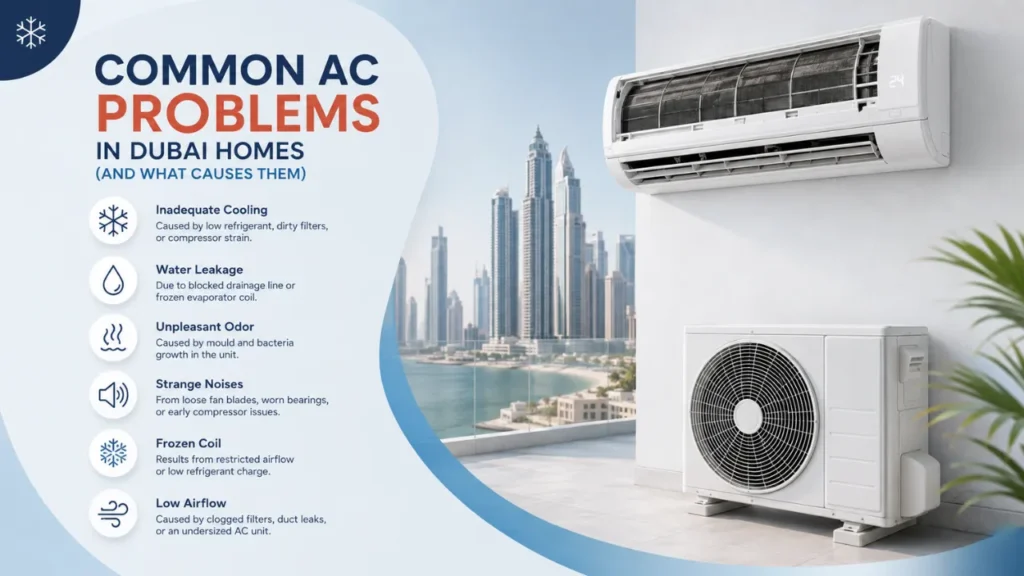
1. AC Not Cooling Effectively
Undoubtedly, it is our top concern during the summer months, from June to September. The unit operates, the fan turns, yet the coolness coming from it does not reach the temperature of cool air required by the hot weather outside.
Common causes:
- Dirty or clogged air filters hindering the flow of air
- Low amount of refrigerant due to slow leakage
- A dirty condenser coil failing to release heat effectively
- Faulty or improperly calibrated thermostat giving wrong signals
Professional solution:
The expert checks static pressure and airflow initially, changes or washes the filters, examines the coil for dirt, and measures the pressure of refrigerant using gauges. If there is little refrigerant, the system undergoes the test for locating the leak; it is repaired and charged again according to the manufacturer’s specifications. It should be noted that only such an approach to the problem gives long-lasting results; otherwise, adding some refrigerant without finding the leak is useless.
2. AC Leaking Water
Seeing water collected under an indoor unit or leaking from the ceiling is quite scary, but most of the time there is nothing major happening; it just has something to do with the draining.
Common causes:
- The clogged condensate drain pipe, mostly due to algae, dust, or other debris
- Damaged or dislocated drain pan
- Frozen evaporator coils that melted and flooded the pan
- Installation problem with the angle of the drain pipe, commonly found in old buildings
Professional solution:
The specialist will clean out the condensate drain pipe with a wet/dry vacuum or nitrogen flush, check the drain pan for any damage or misplacement, and will ensure that the unit is leveled so that water drains properly. In case the cause was frozen coils, the problem with airflow or refrigerant is solved first because just cleaning out the drain won’t help.
3. AC Blowing Warm Air
It’s not just annoying but infuriating when you have an AC system that is running at full tilt, the compressor working and the fan spinning, yet the output air seems to be no cooler than the room temperature air.
Common causes:
- Damage or leakage in the refrigerant, thus weakening the heat absorption capacity of the system
- A failing or damaged compressor
- Electrical problems, such as a tripped capacitor and damaged wiring
- Soiled outdoor condenser failing to release heat
Professional Solution:
Electrical testing (capacitors, contactors, wiring) and a complete check on the refrigerant pressure follow a diagnosis of the problem. One of the more costly repairs is that of a weak or bad compressor. Experienced technicians always factor in the cost of repairs versus the age of the system before making suggestions for repair or replacement of the compressor or even the entire AC system.
4. Strange Noises: Rattling, Buzzing, Grinding, or Squealing
All air conditioners make some noises during operation, but when the tone changes, or a new rattling, buzzing, or grinding noise occurs, it means that the AC wants to tell you about the existing problems.
Common causes:
- Loose panels, screws, or mounting brackets
- Dust, leaves, sand, or little stones inside the outdoor fan
- Motor and fan bearings that wear out
- Broken compressor – this problem often is accompanied by a loud humming noise
Professional solution:
The technician performs the troubleshooting process, operating indoor and outdoor units separately. He tightens all the fasteners, removes all the debris, and examines bearings and motor mounts. The worn bearings and fan motors are replaced, not just oiled, because the temporary fix of the failing motor leads to its burnout during one season.
5. High Indoor Humidity Despite the AC Running
When you feel humidity in your house even when you are running your AC, then your AC isn’t working effectively because AC not only cools your room, but the main purpose of AC is moisture removal.
Common causes:
- Oversized AC that makes the room cold quickly but stops before removing the moisture
- Condensate drain pipe clogged so that moisture is not being removed properly
- Dirty evaporator coils reduce the effectiveness of the dehumidification process
- Wrong settings of the thermostat
Professional Solution:
The technician will check if the capacity of the AC is proportional to the size of the room because the common problem in villas is that AC is installed in a generic manner regardless of its capacity needed for the room.
6. Short Cycling (AC Turning On and Off Repeatedly)
Short cycling occurs when the compressor turns on for several minutes, then off, and turns back on again. This process not only uses up energy but also creates considerable strain on the compressor.
Common causes:
- Dirty air filters that reduce airflow and affect thermostat readings
- The installation of the thermostat near a heat source or directly under the sun
- Oversized unit in the room
- Problems with the refrigerant resulting in pressure imbalance
Professional solution:
Filters get cleaned or replaced, the thermostat gets checked for accuracy and location, and refrigerant levels are examined. In case of the oversizing problem, the specialist will advise you to perform a load calculation in the future.
7. Frozen Evaporator Coils
If you notice ice buildup on the evaporator coils, either visible or within the unit itself, it’s almost always an indication that the balance between airflow and refrigerant is not correct.
Common causes:
- A restriction in the airflow caused by clogged filters or blocked vents
- Lack of refrigerant in the system
- Defective fan or motor
Professional solution:
The unit needs to be switched off until the ice melts (it should never be scraped since this can damage the coils), new filters are installed, the air passages are cleaned, and refrigerant pressure is checked. In most cases of frozen evaporators, the compressor will get damaged when running without figuring out what caused it to freeze, which is one problem for which DIY solutions don’t really apply.
8. Bad Odors From the AC Vents
A musty, sour, or burning odor coming out of the vents is not only annoying but usually a sign of biological contamination or a problem with the electricity.
Common causes:
• Mold or bacteria growing in the moist coils or drain pan
• Buildup of dust and other material in the ducts
• Burning wires or overheated component (this is more of an “electrical” odor)
Professional solution:
Musty odors are dealt with by cleaning the coils, drain pan, and ducts, possibly along with the use of UV and antimicrobial treatments. The burning odor is considered an urgent matter and the system is turned off to check the electrical components, as it may be a sign of a fire hazard.
9. High Electricity Bills Without a Clear Reason
The people living there will only notice that their AC unit is not functioning properly when their DEWA bill comes in much higher than normal.
Common causes:
- Dirty coils and filters requiring the compressor to work overtime
- Either an old system working ineffectively
- Underfilled refrigerant leading to increased time spent running
- Improper scheduling of the thermostat
Professional solution:
An efficiency test, which covers the filters, coils, refrigerant levels, and energy consumption, will normally tell you what the problem is. In some instances, simply having your AC unit maintained properly can lower your bills significantly.
10. AC Unit Won’t Turn On At All
The worst-case situation would be having temperatures at 43°C while the unit won’t turn on.
Common causes:
- Tripped circuit breaker or a blown fuse
- Defective thermostat or thermostat batteries have died out
- Bad capacitor or contactor
- Locked-up compressor due to electrical stress
Professional solution:
Electrical testing comes first; breakers, fuses, capacitors, and contactors are checked one by one. Should the compressor fail, the professional gives an honest evaluation of repairing vs. replacement price – as in many cases, replacing a compressor for an old system will cost almost as much as a new one.
How To Prevent AC Problems
Responding to problems is costly. But prevention is much more cost-effective. Based on our observations during hundreds of visits a year, these practices will make the greatest measurable impact:
- Two preventative maintenance visits per year, preferably one before peak summer months (March–April) and another one after (October), not when problems arise.
- Twice a month or even monthly filter cleaning and replacement period because dust level in the Dubai environment clogs filters way sooner than it usually does in other regions.
- Outdoor condenser should be free of sand, leaves, and debris and not obstructed by anything that may affect the airflow.
- Periodic flushing of the condensate drain line to avoid the accumulation of algae and dust causing leakage.
- Once a year, professional coil and duct cleaning, as visible dust on the outside is only a part of accumulated dirt.
- Maintaining the temperature at realistic levels and not cooling the house unnecessarily to avoid longer operation of the compressor.
- Making adjustments at the first signs of problems and not procrastinating, as a minor problem now may result in a compressor breakdown soon.
DIY Checks vs. When to Call a Professional
There is only a short list of things that can be safely done by DIY enthusiasts: changing a disposable filter, cleaning the outdoor unit from visible debris, and making sure that the thermostat has power and the proper settings. Otherwise, AC repairs in Dubai should be performed by a certified HVAC technician since:
- The manipulation of refrigerant is possible only with a certificate and special equipment, while improper use of it is both illegal and dangerous.
- Electrical issues are associated with fire and electric shock hazards in the system with high-voltage parts.
- Identifying the true cause of a malfunction instead of its symptoms will prevent the same issue from arising again soon.
- The warranty conditions of many AC models sold in the UAE include professional maintenance only.
The basic principle is that if you need to open electrical panels or work with refrigerant, you should better contact a professional.
Choosing the Right AC Repair Company in Dubai
Not all the service people coming in with their tool kits have the same level of expertise. In your hunt for an AC repair Dubai company, seek out one which:
- Is properly licensed and insured, meaning that it is allowed to conduct business in Dubai
- Provides clear quotations before beginning any work, as opposed to giving vague estimates
- Has experience servicing different brands of air conditioners because Dubai houses air conditioners made by LG, Samsung, Daikin, Gree, Carrier, O General, and many others
- Provides a written warranty for parts and services so that if the problem appears again soon after, you know you are protected
In addition, the right people would explain the problem and give reasons why they think it happened.
Conclusions
Air conditioning in Dubai is no luxury; it is a necessity, and considering the weather conditions in Dubai- heat, humidity, and dust- all well-installed systems require regular, competent servicing in order to continue working properly. All of the usual symptoms of AC malfunctions in Dubai, such as weak cooling, water leaks, unusual noises, hot air blowing out, increased humidity or electricity bills, can be attributed to only several main causes – dirtiness of parts, problems with the refrigerant, poor drainage, or electrical wear and tear. Being able to recognize the symptoms, regularly servicing the AC unit, and being aware of when to call an expert from AC repair Dubai is what will allow your system to work without problems for 15 years instead of breaking down every summer. A professional AC repair in Dubai should therefore be founded upon the principle of diagnosis.
This is something that MD Technical Services LLC ought to aim for. The idea is simply to diagnose the problem, understand what caused it, conduct the right kind of repair, and ensure that your AC is working properly again. This could be an AC not cooling, leaking water, inadequate airflow, unusual sounds, refrigerant issues, or other types of AC malfunctions.
If your air conditioner displays any of the symptoms described above, do not wait until you experience its failure in the middle of a heat wave – a timely inspection will most likely be cheaper than a repair of a breakdown.
Frequently Asked Questions
How long can an AC system serve in Dubai?
Well-maintained systems last around 10-15 years in Dubai. However, units that are not serviced or are not maintained regularly tend to face serious problems after 5-7 years due to the hot climate and dusty environment.
How often do I need to maintain my AC unit in Dubai?
Twice a year is recommended, just before and after summer.
Why does my AC give off a bad odor when it starts?
If your AC smells like mold, then there might be an infestation of bacteria and mold in the coils, drain pan, or even in the ducts of your AC system. Otherwise, the bad smell will imply an electrical problem with your AC system.
Is it okay for the AC to have minor leakage of water in Dubai’s humid weather?
Small amounts of condensation are fine, but leaking means a clogged drain pipe or some other problem that needs to be sorted out before it causes ceiling, wall, or floor damage.
Can I simply top up the refrigerant in my AC if it does not cool?
No. Handling of refrigerant needs certification, and topping it up without fixing the cause of leakage is a temporary solution anyway.